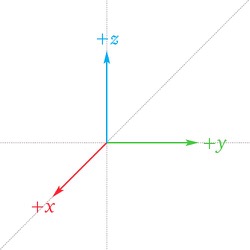


A vector space is a set whose elements are called “vectors” (denoted as $\v{v}$ or $\mathbf{v}$), which have two operations defined on them: addition of vectors and multiplication of a scalar by a vector.
Formally, a vector space $V$ is a set with two operations $+$ and $*$ that satisfy the following properties:
- If $\mathbf{u},\mathbf{v} \in V$, then $\mathbf{u + v} \in V$.
- $\mathbf{u + v} = \mathbf{v + u}$
- $\mathbf{u + (v + w)} = \mathbf{(u + v) + w}$
- There is a special element called the zero vector $\mathbf{0} \in V$ such that $\mathbf{u + 0} = \mathbf{0 + u} = \mathbf{u}$.
- For every $\mathbf{u} \in V$, there’s an inverse element $-\mathbf{u}$ such that $\mathbf{u + (-u)} = \mathbf{0}$.
- If $\mathbf{u} \in V$ and $\alpha \in \mathbb{R}$, then $\alpha\mathbf{u} \in V$.
- $(\alpha + \beta) \mathbf{u} = \alpha \mathbf{u} + \beta \mathbf{u}$
- $\alpha (\beta \mathbf{u}) = (\alpha\beta) \mathbf{u}$
- $1 \cdot \mathbf{u} = \mathbf{u}$
Notable examples of vector spaces:
- Segments on the plane and in space; addition uses the parallelogram law, and multiplication by a scalar scales the segment.
- The set of $n \times n$ matrices, with addition defined by element.
- The set of all polynomials.
- The space consisting of the zero vector alone: ${\mathbf{0}}$.
Vector subspaces
A subset $U \subseteq V$ of a vector space $V$ is a subspace if:
- For all $\mathbf{u,v} \in U$, $\mathbf{u+v} \in U$.
- For all $\alpha \in \mathbb{R}$ and $\mathbf{u} \in U$, $\alpha \mathbf{u} \in U$.
Linear dependence
A set of vectors is linearly dependent if one element from the set can be written as a linear combination of the other elements in the set. If this cannot be done, then the set is linearly independent, which is also known as a basis for some vector space. The dimension is the number of elements in the basis. If $\mathbf{b_1, b_2, \ldots, b_n}$ is a basis, then any linear combination of the basis will have the form:
The numbers $a_1, a_2, \ldots, a_n$ are called the components of $\mathbf{v}$ in the specified basis. Note that the basis doesn’t need to be orthogonal nor have unit vectors.
The set of vectors $[1,0,0], [0,1,0], [0,0,1]$ is an example of a basis of dimension 3
Linear maps
A map between vector spaces is linear if it preserves addition and multiplication with scalars as defined above. Formally, a map $L: U \rightarrow V$ is linear if:
- For all $\mathbf{u,v} \in U$, $L(\mathbf{u,v}) = L(\mathbf{u}) + L(\mathbf{v})$.
- For all $\alpha \in \mathbb{R}$ and $\mathbf{u} \in U$, $L(\alpha \mathbf{u}) = \alpha L(\mathbf{u})$.
Additional operations
Norm
The norm of a vector is denoted by $\norm{\mathbf{v}}$ and satisfies:
- $\norm{\mathbf{v}} \geq 0$; $\norm{\mathbf{v}} = 0$ only if $\mathbf{v} = \mathbf{0}$.
- $\norm{\alpha \mathbf{v}} = \alpha \norm{\mathbf{v}}$.
- $\norm{\mathbf{v_1} + \mathbf{v_2}} \leq \norm{\mathbf{v_1}} + \norm{\mathbf{v_2}}$ (triangle inequality).
Scalar product
The scalar product of two vectors is a function $f: V \times V \rightarrow \mathbb{R}$. The function is commonly denoted as $\left \langle \mathbf{v_1}, \mathbf{v_2} \right \rangle$ and satisfies:
- $\left \langle \mathbf{w, (u + v)} \right \rangle = \left \langle \mathbf{w,u} \right \rangle + \left \langle \mathbf{w,v} \right \rangle$.
- $\left \langle \mathbf{w},\alpha \mathbf{v} \right \rangle = \alpha \left \langle \mathbf{w,v} \right \rangle$.
- $\left \langle \mathbf{v,v} \right \rangle \geq 0.