

My Goals
- I want to connect with people better - Whenever I meet new people, I try to guess where they’re from. If I know a few words of their language, I try to speak them, and I immediately see how they light up1. I get happier when I make other people happy 🙂.
- It’s a fun activity to do - It’s a hobby, and I look forward to practicing it, which is important for motivation.
If you talk to a man in a language he understands, that goes to his head. If you talk to him in his language, that goes to his heart.
Nelson Mandela
Why Japanese?
I decided to learn Japanese because:
- It makes me appreciate Japanese culture more - After traveling to Japan, I realized I have a very deep appreciation for its culture. I find it interesting that there are many ways of expressing yourself based on how polite you want to be.
- It’s way different from other languages - It’s very different from the languages I already know (English, Spanish, French). I think it’s hard to learn Japanese words because you have to remember the meaning, the shape, and the sound. But I’m ready for the challenge!
- I like to listen to songs in Japanese - When I used to watch more anime, I enjoyed Naruto’s openings and endings, like Seishun Kyousoukyoku by Sambomaster or Harmonia by Rythem . Since then, I have started enjoying listening to Japanese pop music with artists like Sheena Ringo , Hikaru Utada , Ado (Her voice is amazing and her persona is so unique), Atarashii Gakko! (Suzuka has such a strong chest voice), ZUTOMAYO (ACAね is a genius: she is a composer, she can play guitar and other instruments live, and she is an amazing singer. I can’t believe she can sing Time Left live). YOASOBI (although some of their music is too happy for me :)). I also like metal bands like Baby Metal , Band Maid and Ningen Isu .
- Japanese Content - There is a lot of content available in Japanese that I’m interested in watching like Gaki No Tsukai . I found them through their Silent Library 2 series and then discovered their “No-laughing” batsu games, they’re so hilarious!
In my journey, I have realized that:
- I can only learn the language through discipline - Like learning any other skill, it requires me to be consistent. This means practicing whenever I have the opportunity. Some days I might not feel like learning it, but I know that just trying for a few minutes will help. Anyway, even if I don’t have the motivation to practice, I do it anyway.
- You get as much as you put in - No matter what method I use, I’m not going to learn it if I don’t practice a lot.
- Having an imperfect accent is okay - I know that I have an accent when I speak and that’s okay. My accent is what makes me unique. My goal is for the person or people I’m talking to to understand me, and if they can, then that’s it. Having an accent is not an excuse to stop learning other things about the language though. I do put effort into learning new words and grammar.
Progression
I am applying the concept of Comprehensible Input to learning Japanese. If you want to know more details about it, you can watch this video .
Similar to my strategy for learning French , I’m consuming Japanese content that I can understand. My favorite platforms are YouTube and Stremio (where I can watch anime).
Understanding Japanese content in videos
I am using my own Chrome extension called Subtitle Insights to get smart insights and translations while watching videos. My current setup involves enabling the overlay where I attempt to read the sentence (in Kanji and Kana) without the translation enabled (which I disable to force myself to practice reading and recalling content that I learned). If I want a translation of the sentence, I can see it in the extension sidebar. If there’s a part of the sentence that I don’t understand, I read the “insights” which explain parts of the grammar. I configured the extension to use this system prompt:
Show grammar prompt
Role: Japanese Grammar Instructor for English speakers.

Task: Analyze the grammar of the user's provided Japanese sentence.

Constraints:
- PROSE LANGUAGE: Use English for the explanation.
- NO JAPANESE PROSE: Never write full sentences in Japanese.
- NO TRANSLATION: Never translate the sentence.
- KEY TERMS: Use Hiragana/Katakana for particles (は, が, を, に, etc.)
  and specific vocabulary, focus on explaining grammar.
- BREVITY: 1-2 sentences maximum.
- START: Begin the explanation immediately with no filler.

RESPONSE RULE: Your response MUST have an English word

Example:
Input: 今日はカエル探偵というゲームをやります。
Output: The phrase 「今日は」 (kyō wa) indicates "today,"
acting as a topic marker (は-particle).
「という」 (to iu) is used to introduce the name of the game,
"カエル探偵" (kaeru tantei), which means "Frog Detective."

Example:
Input: 始めるをクリックします。
Output: 「をクリックします」 (o kurikko shimasu) means "click on."
「を」 (o) marks 「始める」 (hajimeru - to begin) as the direct object of the verb
「クリックします」 (kurikko shimasu - to click).
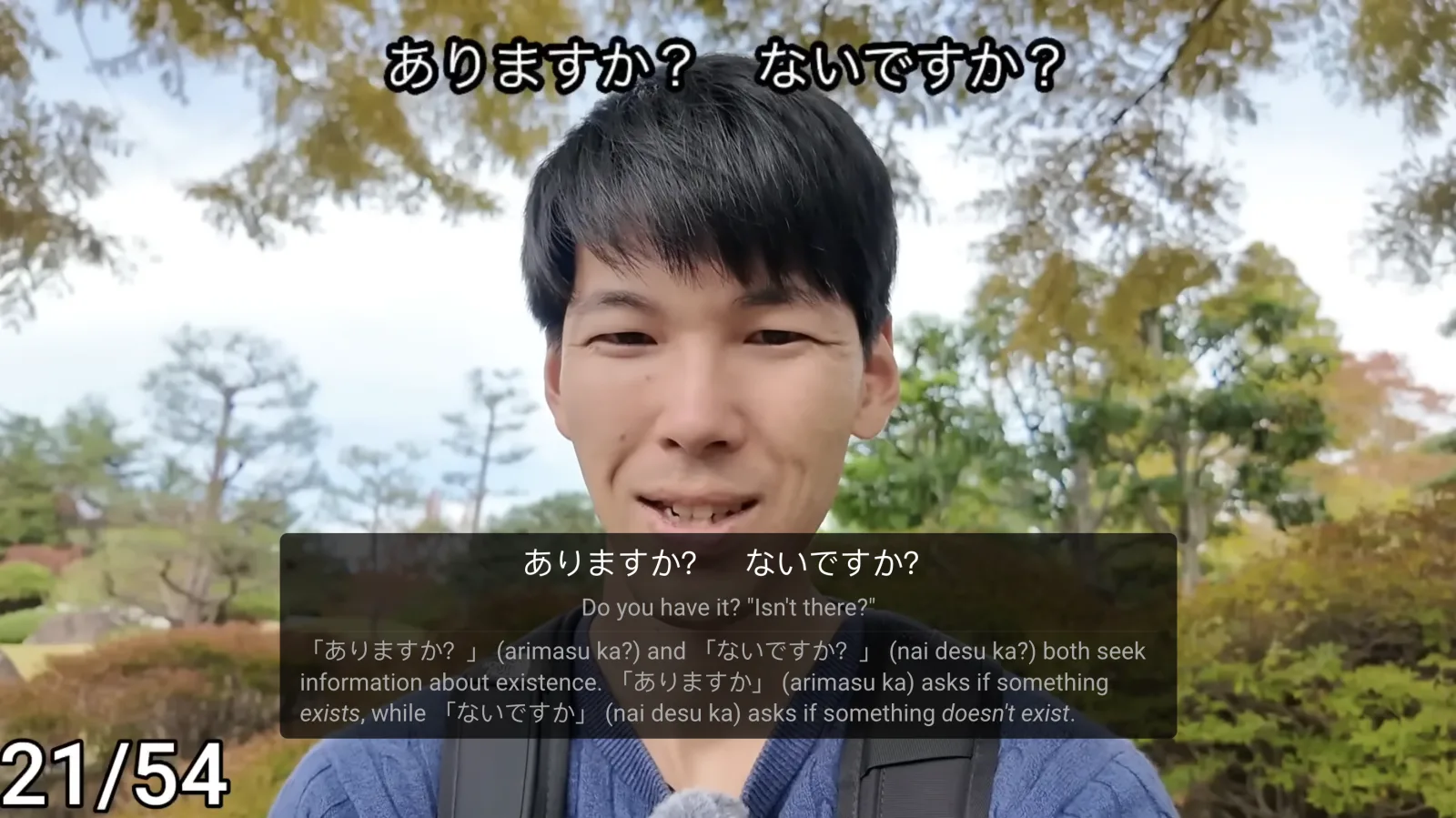
Subtitle Insights showing a Japanese sentence with grammar insights
Pausing, shadowing and replaying
When I’m actively learning (i.e., when I’m not consuming content passively), I want to understand most of the details worth understanding in the sentence, if not every word. I realized I needed to pause the video at the end to attempt to understand words from the subtitle with Yomitan 3. I also wanted to shadow the speaker by replaying the current subtitle from where it begins. While Yomitan gives me per-word explanations, I also wished I could get deeper insights into a sentence, such as understanding the grammar, particles, and choice of verb endings. I’m able to do all of these with my extension , which is working wonderfully for me.
Deep grammar explanations
Japanese has multiple ways to express causality (like から - kara vs ので - node),
and choosing the right one depends on politeness and sentence structure. While watching a video, I press Command+Ctrl+g
(the default shortcut to trigger Gemini in Chrome) and ask Gemini to explain the specific nuances.
Because Gemini in Chrome has awareness of your current page and context, it can provide highly relevant answers.
I wrote more details about this workflow in this guide
.
Mining Words with Yomitan
I have configured Yomitan with the Jitendex.org index and the BCCWJ frequency dictionary. As a result, when I hover over a new word I get to see: how it’s pronounced in Furigana, its meanings, and how often it appears. Knowing how often it appears is very useful because if a word appears often in text it should be very high on the list of words I learn first. I wrote more details about how I mine words with Yomitan and my extension in this guide .
Reviewing mined vocabulary in Anki
The ‘Forgetting Curve’ suggests that without review, you lose 70% of new vocabulary within 24 hours. This is where Anki and its spaced repetition system helps, with Anki, I can review a word just before I forget it. Moreover, the word frequency data exported by Yomitan helps sort the list of words that I learn, therefore, I’m sure I’m learning words that really matter at this stage of my learning process and not learning words that I’ll rarely use.
Adding more content to mined words
Mnemonics
Japanese words may have Kanji in addition to Kana. To remember Kanji and Kana, I use an AI-powered workflow that creates mnemonics focused on three things: meaning, shape, and sound. It’s much simpler to look at the strokes that form the character and remember a story around it, which eventually helps me recall the meaning, shape, and sound. This has worked wonderfully for me so far.
While I could create these by hand, I have a script that scans my list of recently learned words from Anki and adds notes to it.
Show mnemonic prompt
You are a Japanese Mnemonic Specialist.

Your sole task is to generate creative, memorable,
and slightly humorous mnemonics for Japanese words and kanji.

The expression is: "{Expression}" (Reading: "{ExpressionReading}").

It appeared in the sentence: "{Sentence}"

### Rules:
1. NEVER critique the prompt.
2. ALWAYS follow the exact format provided.
3. **BOLDING:** Always bold the **Core Meaning**,
   the **Kanji Radicals**, and the **English Pun** that mimics the sound.
4. For the "Shape" section, break down the kanji into its radicals or
   components.
5. For the "Sound" section, use English puns or stories that sound
   like the Japanese reading.
6. Create a mnemonic for the expression only.
   The sentence I provided is just for additional context to help explain
   the mnemonic. Don't create mnemonics for the rest of the sentence.

### Output Format:

The Mnemonic: "[Title]"

Meaning: **[Brief Meaning]** ({Expression})

Shape: [Visual connection. Mention radicals like **[Radical Name]**
and **[Radical Name]** in bold.]

Sound: [Creative story/pun. The English pun **[SOUND PUN]** must be
in bold to connect it to the reading **{ExpressionReading}**.]
Expression,ExpressionReadingandSentencewere all mined from Yomitan. I replace their contents with a newly mined word like聞くand I see the following:
The Mnemonic: "The Eavesdropper's Fate"

Meaning: To hear, listen, or ask (聞く).

Shape: You press your ear (耳) against the large wooden gate (門)
to overhear the secrets being whispered inside.

Sound: Watch out! If the guards catch you spying at the gate,
they will kick you! (きく).
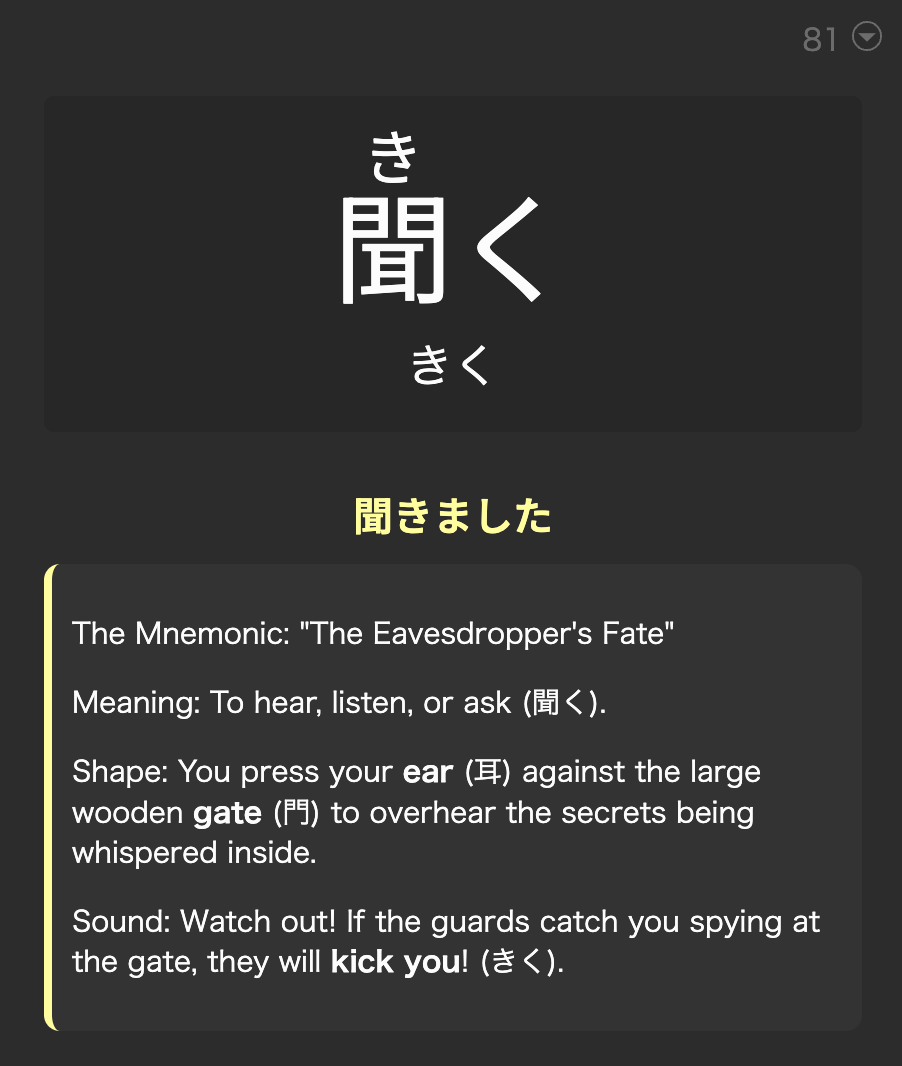
My Anki template with mnemonics generated by AI
i+1 method from Kaishi 1.5k deck
I also learn with the
Kaishi 1.5k deck
which has a curated list of
words. The deck follows a i+1 method where you see one new piece of information, each card introduces a single
new target word and provides a sentence composed entirely of words learned in previous cards.
This approach shares the exact same sentence across 2 or 3 different target words!
- Target Word A: あなた (You) → Sentence:
あなたはトムさんですか。 - Target Word B: さん (San) → Sentence:
あなたはトムさんですか。
This ensures that when moving from Word A to Word B, I see something familiar and reinforces the grammar and vocabulary of the shared sentence.
I really like that methodology, unfortunately, when mining words with Yomitan it can only see the sentence where the word was retrieved from which might have a lot of words that are still unknown.
However, with AI agents is easy to express these constraints to add context to mined words using this methodology. The plan that I wrote with the agent is:
Show i+1 sentence prompt
# Specification: i+1 Sentence Reinforcement for Japanese::Mining

This track aims to enrich the `Japanese::Mining` Anki deck by populating the `Sentence`,
`SentenceFurigana`, and `SentenceEnglish` fields with high-quality "i+1" sentences.
These sentences will be specifically designed to reinforce vocabulary you have
already learned in both the `Japanese::Kaishi 1.5k` and `Japanese::Mining` decks.

## Functional Requirements

1. **Vocabulary Extraction:**
   - Identify "learned" words from both the `Japanese::Kaishi 1.5k` and
     `Japanese::Mining` decks.
   - A word is considered "learned" if its card interval is greater than 0 (`Interval > 0`).

2. **Target Prioritization:**
   - Process target words in the `Japanese::Mining` deck sorted by the `FreqSort` field.

3. **Sentence Generation (i+1):**
   - For each target word, generate a sentence where the target word is the only "new" piece of vocabulary.
   - All other vocabulary in the sentence must be from the "learned" word list.
   - Grammar should be "Dynamic," matching the approximate level of the learned vocabulary.
   - The context should focus on "Daily Life" situations.

4. **Field Population:**
   - **Sentence:** The raw Japanese sentence with the target word highlighted (e.g., in bold).
   - **SentenceFurigana:** The sentence using Anki's standard furigana format (`漢字[ふりがな]`).
   - **SentenceEnglish:** A clear English translation of the generated sentence.

5. **Automation:**
   - Use AI (Gemini) to generate the sentences and translations based on the
     provided "learned" context.
After processing my deck now I see the words that I learned in sentences created by the AI agent with words seen in the past. This is excellent because I can practice reading and recalling the meaning of other words while adding a new word to my vocabulary!
Producing Japanese
Producing mined words
Reading mined sentences has helped me understand and recognize words that I hear in videos and at meetups, but recognition is different from producing a word when I want to speak. To practice production, I added another view of my mined words in Anki. These are not new cards. They are the same mined words shown in a different way.
The front of the card shows a complete sentence in English and hides the Japanese sentence. My goal is to say the whole sentence in Japanese, including the target word somewhere in the sentence. After I answer, the back reveals the Japanese sentence, the target word, its meaning, and the rest of the card context. This gives me a reason to retrieve the word instead of only recognizing it when I see it.
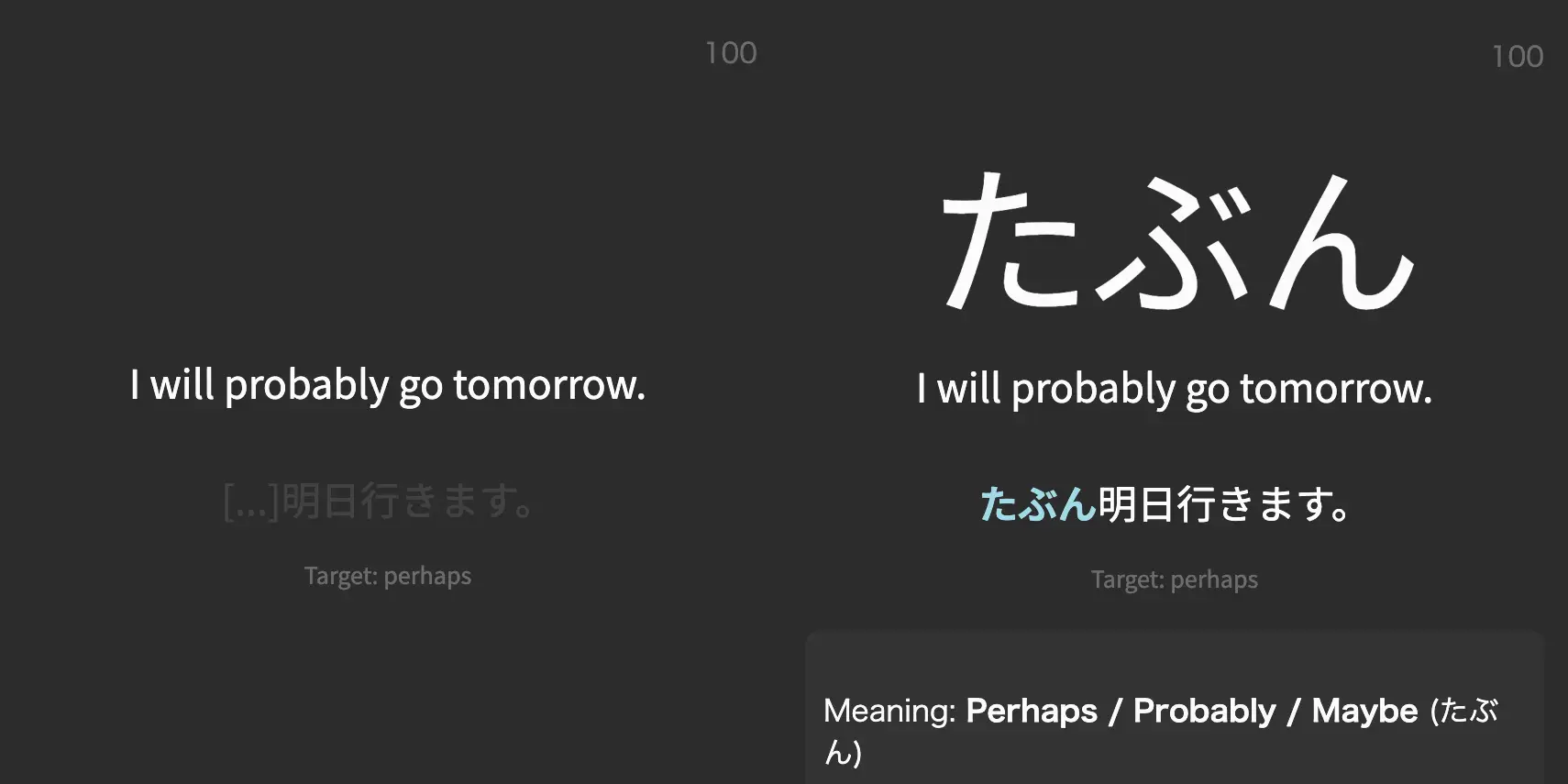
A mined word card adapted for Japanese production practice
Producing grammar
I also created a separate Japanese Grammar Production deck for learning grammar through examples. The deck is reusable across grammar lessons, so each lesson can add new production exercises without requiring a different card format.
Each card follows the same production loop as the mined-word view. I read a sentence in English and try to say it in Japanese. A word or set of words is hidden in the Japanese sentence using Anki’s Cloze format, and I only see it after revealing the back of the card. The back shows the complete sentence with furigana, the grammar transformation, a short explanation, and sentence audio.
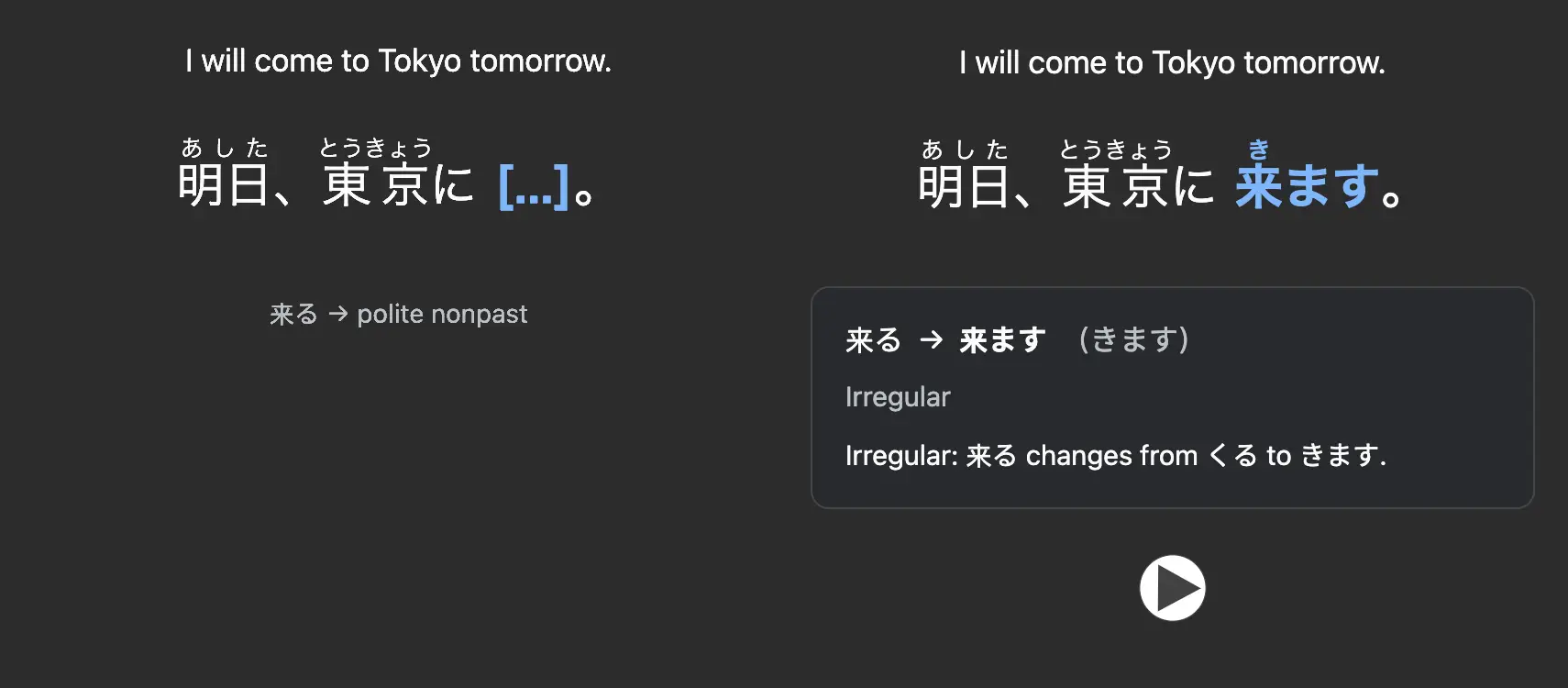
A Japanese Grammar Production card before and after revealing the answer
The grammar deck is separate from my Japanese Mining deck. Mining and Kaishi provide vocabulary context so that
the examples can stay close to an i+1 level, while the grammar cards focus on deliberately producing a form.
Conversation Starters
To practice the language with native speakers at meetups, I’ve created a small flashcard game where I can practice common questions and their possible answers. I use it when I want to be the one asking questions to keep the conversation going!
You can find the tool here: Japanese Conversation Starter
Visiting Japan in the future
Another reason why I decided to learn Japanese is that I’m planning to visit Japan again. I enjoyed my stay there a lot, and I miss it dearly! I’ll leave this image here as motivation, reminding me of how happy I felt while staying there.

Me enjoying Japan
-
laoshu50500 was a polyglot YouTuber and a language teacher who recorded his interactions with people in lots of languages. Watch a few videos and you’ll see how good it feels to talk with someone else in their native language. RIP Moses. ↩︎
-
The Silent Library series is so popular worldwide that many other countries created their own version. I used to watch the show on MTV but at the time I didn’t know it was originally created by them. ↩︎
-
Yomitan is a powerful browser extension that allows you to instantly look up Japanese words and grammar by hovering over text. ↩︎