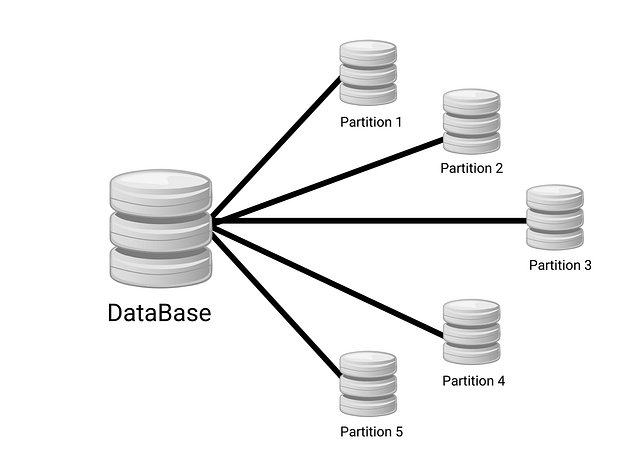


With replication
- Copies of each partition are stored in multiple nodes
Partitioning strategies
- Unfair partitioning may lead to hotspots (e.g., nodes with more data than others).
- Assigning records randomly makes data unreadable.
- By range (e.g., given a dictionary with sorted keys, Node 1 can have words from A to B, Node 2 from B to C, etc.).
- Within each partition, keys are stored in order.
- Range scans are easy.
- This may lead to hotspots (e.g., if all keys belong to the range A to B, Node 1 will become the hotspot).
- By hash key (e.g., take the hash key of the key and assign it to a range, using consistent hashing).
- It distributes data evenly.
- No range scans are possible.
- Cassandra allows a multi-column primary key; the first part of the key is hashed to determine the partition, and the other columns are used as a concatenated index for SSTables.
- A hybrid approach can be taken with skewed workloads (e.g., where all writes/reads are for the same key).
- Append two digits to the key (e.g., key00, key01, …, key99). This introduces a tradeoff with read performance.
Rebalancing partitions
Things that change in a database over time:
- More throughput requires more CPU, RAM, and disk, leading to vertical scaling.
- A machine fails, and other machines need to take over its responsibilities.
Rebalancing requirements:
- Load should be fairly shared.
- The database should accept reads/writes while it’s being rebalanced.
- No more data than necessary should be moved (to minimize I/O).
Strategies:
- Fixed number of partitions (Riak):
- When the number of partitions is greater than the number of nodes, multiple partitions are assigned to each node.
- When a new node is added, it steals some partitions from every other node.
- When a node is removed, it distributes its partitions to every other node.
- The number of partitions is fixed when the database is set up and is not changed afterward.
- Choosing the number of partitions is difficult if the size of the dataset varies.
- Dynamic partitioning (MongoDB):
- A partition is split once it reaches a limit or merged if it has very little data.
- The number of partitions adapts to the dataset’s size.
- An empty database starts with a single partition, and all writes are directed to the same node; consequently, the other nodes remain idle.
- Partitioning proportionally to nodes (Cassandra):
- There is a fixed number of partitions per node; partitions grow without affecting the nodes.
- When a node is added, the partitions become smaller, and the data is redistributed.
Request routing
Problem: How does a client know which node to connect to?
- Clients can connect to any node via a round-robin load balancer.
- Cassandra and Riak use a gossip protocol to inform about changes in the cluster.
- A request can be sent to any node, which forwards it to the appropriate node.
- This puts more complexity on the database to avoid a dependency.
- Requests are sent to a routing tier acting as a partition-aware load balancer.
- ZooKeeper is a coordination service that keeps track of the cluster metadata, mapping partitions to nodes. Whenever a partition is created, updated, or removed, ZooKeeper notifies the routing tier.
- The client is aware of the partition and doesn’t need an intermediary.