Kafka
https://www.slideshare.net/mumrah/kafka-talk-tri-hug
Key Choices
- pub/sub messaging pattern
- Messages are persistent (stored on disk).
- Consumers keep their own state (stored in Zookeeper).
Technology Summary
| Concept | Notes |
|---|---|
| Brokers | Receive messages from producers (sequential write, push) and deliver messages to consumers (sequential read, pull). Messages are flushed to append-only log files. |
| Topics | A logical collection of partitions mapped across many brokers. |
| Partition | Physical append-only log files. A broker contains some of the partitions for a topic. |
| Replication | Partitions are replicated. One broker is the leader, and all writes/reads must go through it (replication is for fault tolerance only). Replication can be tuned to write to N replicas. |
| Producer | Responsible for load balancing messages among brokers. They can discover all brokers from a single one. High-level API: Producer#send(String topic, K key, V value).Determines the partition based on the key (default hash mod), e.g., send("A", "foo", message) in the example below: "foo" mod 2.No total ordering across partitions. Guaranteed ordering inside the partition. This is useful if the key is a PK; if so, all the messages related to that key will be ordered. |
| Consumer | Requests a range of messages from a broker. Responsible for its own state, i.e., its own iterator. High-level API: Map<String, List<KafkaStream>> Consumer.connector(Collections.singletonMap("topic", nPartitions)).Blocking/non-blocking behavior. |
| Consumer Group | Multiple consumers can be part of a consumer group coordinated with Zookeeper. In a group, each partition will be consumed by exactly one consumer. Consequence: broadcast/pub-sub (if all the consumer instances have different consumer groups) and load balance/queue (if all the consumer instances have the same consumer group). |
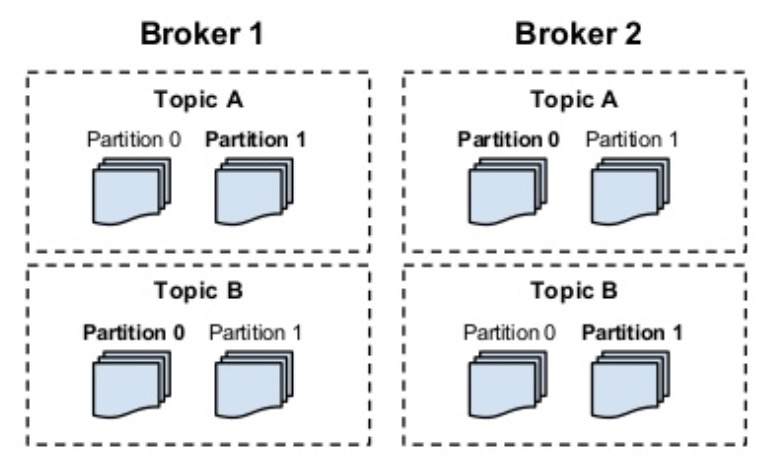
Broker - Partition - Topic
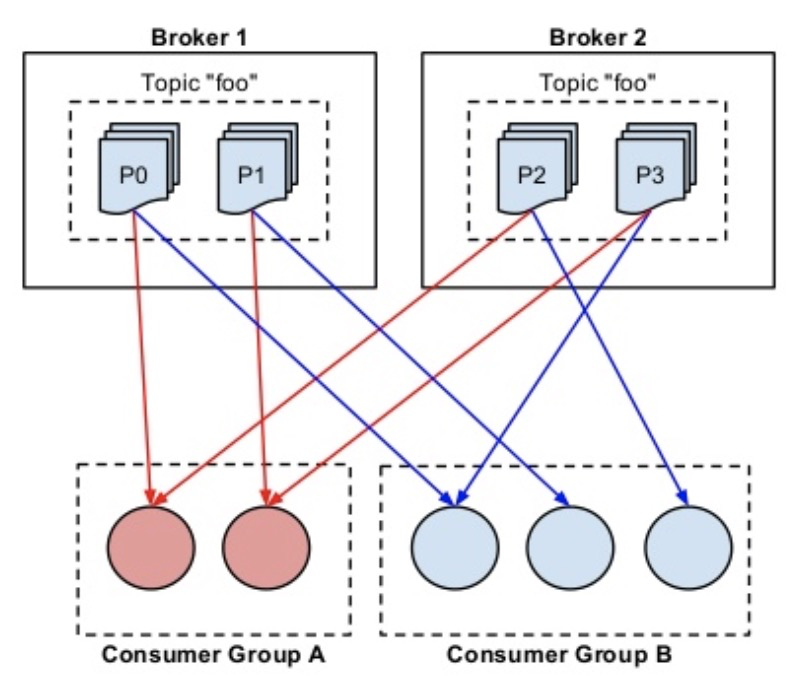
Consumer Groups
Useful numbers
- 50MB/s (producer throughput), 100 MB/s (consumer throughput)
- https://engineering.linkedin.com/kafka/benchmarking-apache-kafka-2-million-writes-second-three-cheap-machines
Applications
- Notification: A updates a record and sends a “record updated” message. B consumes the message and asks A for the updated record to sync its copy.
- Stream Processing: Data is produced and written into Kafka. Consumer groups process these messages and write them back to Kafka.