A ray tracer emits a ray from each pixel toward the scene to determine the color of the pixel. The process of computing the color can be split into three parts:
- Ray generation: The origin and direction of each pixel ray are computed.
- Ray intersection: The ray finds the closest object intersecting the viewing ray.
- Shading: The intersection point, surface normal, and other information are used to determine the color of the pixel.
A ray can be represented with a 3D parametric line from the eye $\mathbf{e}$ to a point $\mathbf{s}$ on the image plane as:
$$ \mathbf{p}(t) = \mathbf{e} + t(\mathbf{ s - e }) $$
Note that:
- $\mathbf{p}(0) = \mathbf{e}$
- $\mathbf{p}(1) = \mathbf{s}$
- If $0 < t_1 < t_2$, then $\mathbf{p}(t_1)$ is closer to $\mathbf{e}$ than $\mathbf{p}(t_2)$.
- If $t < 0$, then $\mathbf{p}(t)$ is behind $\mathbf{e}$.
Camera Coordinate System
All the rays start from the origin of an orthonormal coordinate frame known as the camera/eye coordinate system. In this frame, the camera is looking at the negative $\mathbf{w}$ axis.
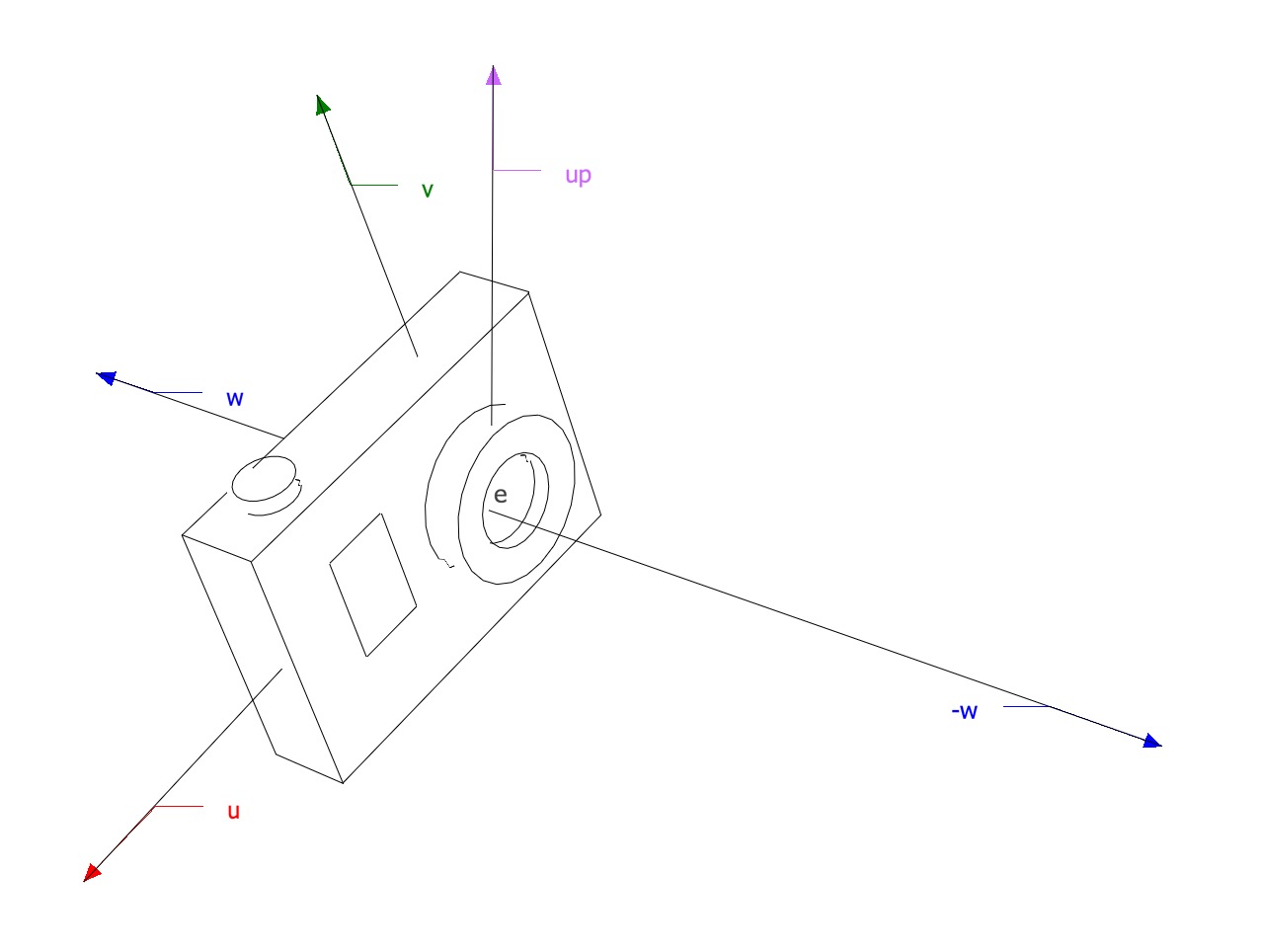
Camera
The coordinate system is built from:
- The viewpoint $\mathbf{e}$, which is at the origin of the camera coordinate system.
- The view direction, which is $\mathbf{-w}$.
- The up vector, which is used to construct a basis that has $\mathbf{v}$ and $\mathbf{w}$ in the plane defined by the view direction and the up vector.
Ray Generation
Pixel Coordinates
The image dimensions are defined with four numbers:
- $l, r$: the position of the left and right edges.
- $t, b$: the position of the top and bottom edges.
Note that the coordinates are expressed in the camera coordinate frame defined in a plane parallel to the $w=0$ plane (the $w=0$ plane is defined by the point $\mathbf{e}$ and the vectors $\mathbf{u}$ and $\mathbf{v}$).
The image has to be fitted within a rectangle of $n_x \times n_y$ pixels. For example, the pixel $(0,0)$ has the position $(l + 0.5 \tfrac{r - l}{n_x}, b + 0.5 \tfrac{t - b}{n_y})$. Note that the half-pixel measurement times pixel-dimension is because of the way a pixel is defined (see rendering ). A pixel with coordinates $(x, y)$ will have the position:
$$ \begin{align*} u = l + (x + 0.5) \frac{r - l}{n_x} \ v = b + (y + 0.5) \frac{t - b}{n_y} \end{align*} $$
Orthographic View
For an orthographic view, all the rays will have the direction $-\mathbf{w}$. There isn’t a particular viewpoint; however, we can define all the rays to be emitted from the $w=0$ plane using the pixel’s image-plane position as the ray’s starting point.
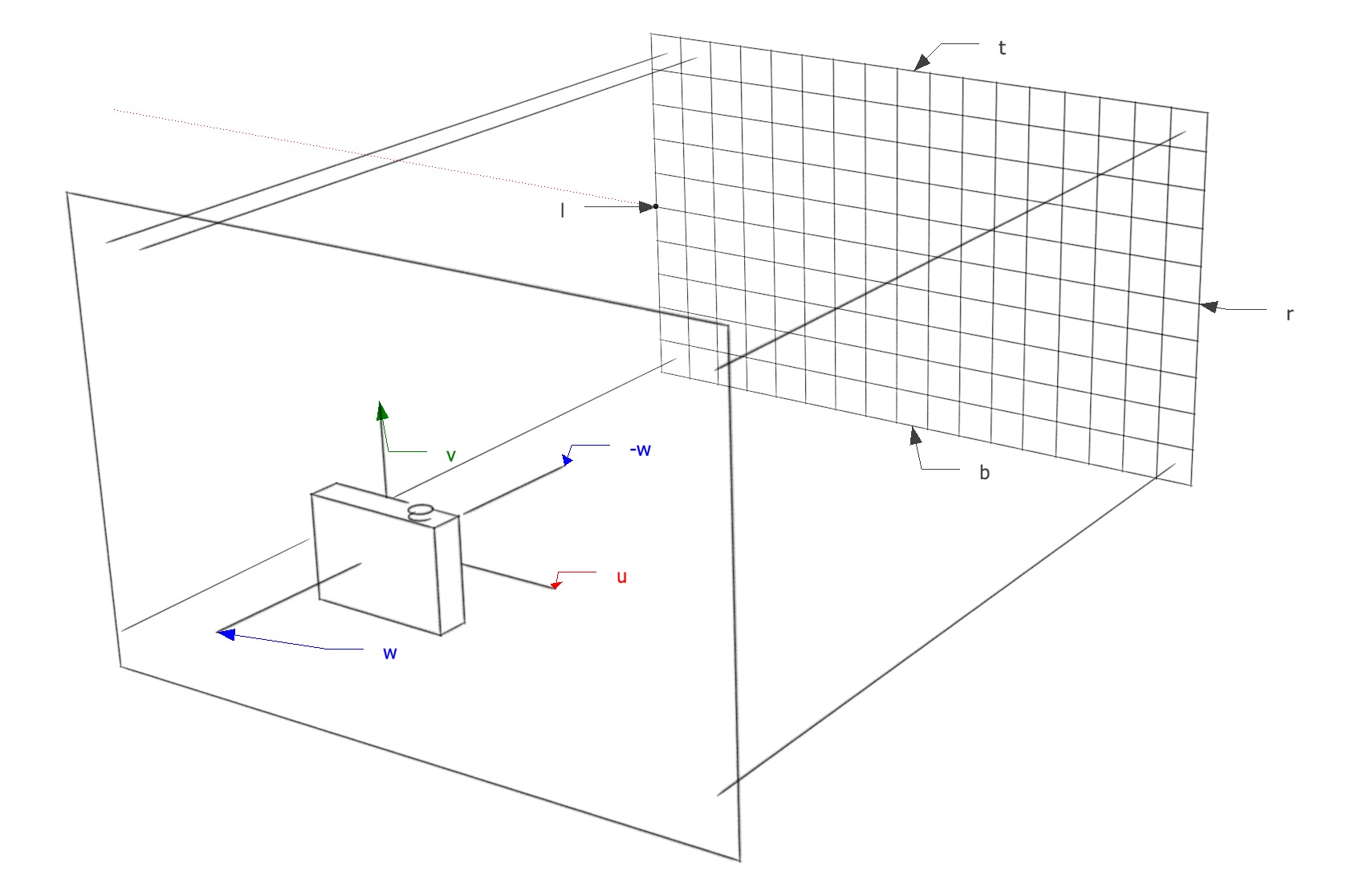
Orthographic View
$$ \begin{align*} \mathbf{ray_{direction}} &= -\mathbf{w} \ \mathbf{ray_{origin}} &= \mathbf{e} + u \mathbf{u} + v \mathbf{v} \end{align*} $$
Perspective View
For a perspective view, all the rays will have the same origin $e$, but the image-plane is not located at $w=0$ but at some distance $d$ in the $-\mathbf{w}$ direction. This time, each ray will have a varying direction based on the location of the pixel’s image-plane position with respect to $e$.
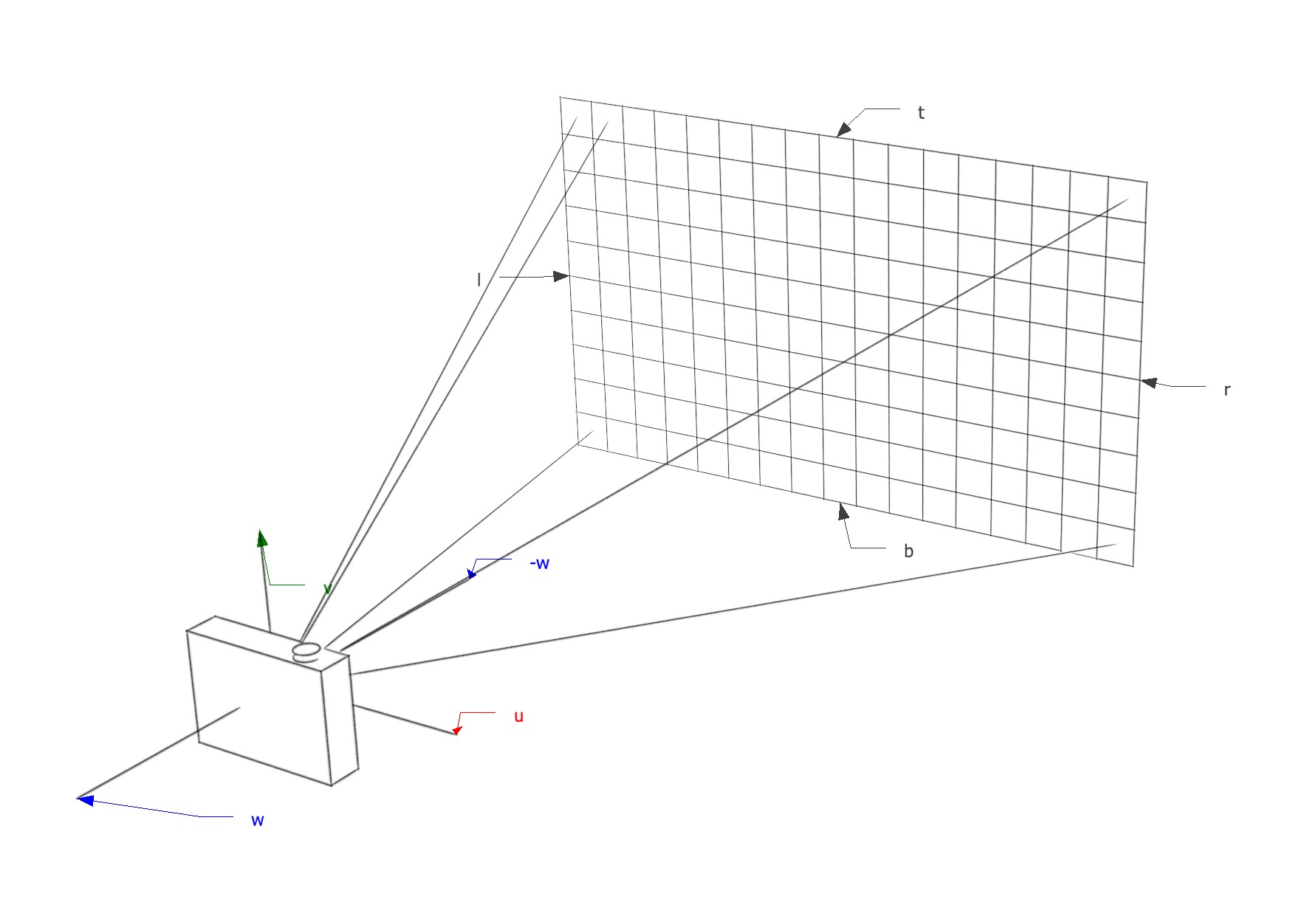
Perspective View
$$ \begin{align*} \mathbf{ray_{direction}} &= -d \mathbf{w} + u \mathbf{u} + v \mathbf{v} \ \mathbf{ray_{origin}} &= \mathbf{e} \end{align*} $$
Ray Intersection
Once a ray in the form $\mathbf{e} + t\mathbf{d}$ is generated, we find the first intersection with an object where $t > 0$. Whenever there are many objects that intersect a ray, the intersection point with the lowest $t$ is returned.
The following pseudocode tests for “hits”:
ray = e + td
t = infinity
for each `object` in the scene
  if `object` is hit by `ray` and `ray's t` < `t`
    hit object = `object`
    t = `ray's t`
return hit t < infinity
Shading
Once the visible surface is known, the next step is to compute the color of the pixel using a shading model. The variables involved (the intersection point $\mathbf{p}$, light direction $\mathbf{l}$, view direction $\mathbf{v}$, and surface normal $\mathbf{n}$) and the models built from them, from flat and Lambertian through Blinn-Phong and ambient, are covered in Surface Shading .