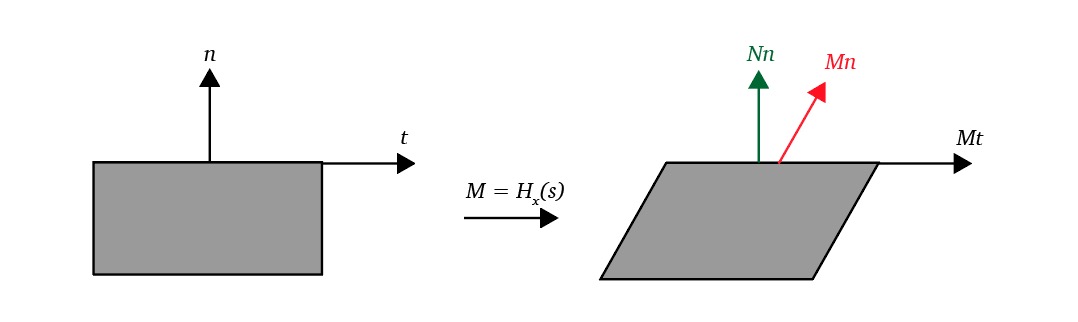


2D Shearing
In 2D, we can skew points towards the $x$-axis by making $x^\prime = x + sy$. If $s > 0$, then points will skew towards the positive $x$-axis; if $s < 0$, points will move towards the negative $x$-axis.
The transformation matrix that skews points towards the $x$-axis is:
$$ \mathbf{H_x}(s) = \begin{bmatrix} 1 & s \\ 0 & 1 \end{bmatrix} $$
Towards the $y$-axis is:
$$ \mathbf{H_y}(s) = \begin{bmatrix} 1 & 0 \\ s & 1 \end{bmatrix} $$
For example, a vector $\mathbf{v}$ multiplied by the matrix above results in:
$$ \mathbf{v^\prime} = \mathbf{H_x}(s)\mathbf{v} = \begin{bmatrix} 1 & s \\ 0 & 1 \end{bmatrix} \begin{bmatrix} v_x \\ v_y \end{bmatrix} = \begin{bmatrix} v_x + sv_y \\ v_y \end{bmatrix} $$
3D Shearing
The notation $\mathbf{H_{xy}}$ indicates that the $x$ and $y$ coordinates are shifted by the other coordinate, $z$, i.e.:
$$ \begin{align*} x^\prime &= x + sz \\ y^\prime &= y + tz \\ z^\prime &= z \end{align*} $$
The shearing matrices in 3D are:
$$ \mathbf{H_{xy}}(s,t) = \begin{bmatrix} 1 & 0 & s \\ 0 & 1 & t \\ 0 & 0 & 1 \end{bmatrix} $$
$$ \mathbf{H_{xz}}(s,t) = \begin{bmatrix} 1 & s & 0 \\ 0 & 1 & 0 \\ 0 & t & 1 \end{bmatrix} $$
$$ \mathbf{H_{yz}}(s,t) = \begin{bmatrix} 1 & 0 & 0 \\ s & 1 & 0 \\ t & 0 & 1 \end{bmatrix} $$
For example, a vector $\mathbf{v}$ multiplied by $\mathbf{H_{xy}}(s,t)$ results in:
$$ \mathbf{v^\prime} = \mathbf{H_{xy}}(s,t) \mathbf{v} = \begin{bmatrix} 1 & 0 & s \\ 0 & 1 & t \\ 0 & 0 & 1 \end{bmatrix} \begin{bmatrix} v_x \\ v_y \\ v_z \end{bmatrix} = \begin{bmatrix} v_x + sv_z \\ v_y + tv_z \\ v_z \end{bmatrix} $$