

The canonical view volume is a cube with corners at $[-1, -1, -1]$ and $[1, 1, 1]$. Coordinates in this cube are called normalized device coordinates (NDC). The projection step maps the region of the scene we want to render, the view volume, into this cube using the projection matrix:
$$ \mathbf{v}_{ndc} = \mathbf{M}_{proj} \mathbf{v}_{view} $$
Points in view space that fall outside the view volume are discarded after the transformation. This process is called clipping : a point is discarded when any of its NDC coordinates lies outside $[-1, 1]$, which is why the canonical view volume matters.
The projection happens in two stages. The matrix maps view space to clip space, and a final division by the $w$-coordinate maps clip space to NDC:
$$ \mathbf{v}_{clip} = \mathbf{M}_{proj} \mathbf{v}_{view}, \qquad \mathbf{v}_{ndc} = \frac{\mathbf{v}_{clip}}{w_{clip}} $$
For an orthographic projection the $w$-coordinate stays $1$ and the division is a no-op. For a perspective projection the division by $-z$ is what makes distant objects appear smaller, and the $w$-coordinate carries that division. The two cases are derived in the next sections.
The basic projection primitives, projecting a point onto an axis or plane and the perspective divide, are covered in Orthographic Projection and Perspective Projection .
Orthographic Projection
An orthographic projection matrix is built with six parameters:
- left, right: planes in the $x$-axis
- bottom, top: planes in the $y$-axis
- near, far: planes in the $z$-axis
These parameters bound the view volume, which is an axis-aligned bounding box.
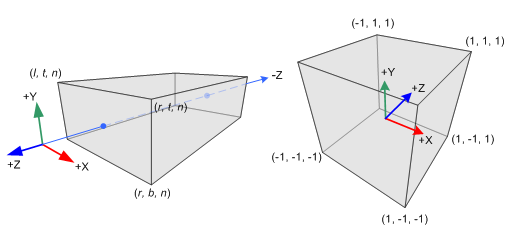
Orthographic Projection
The range $[l, r]$ maps linearly to $[-1, 1]$. Split the mapping in two: $g(x)$ normalizes the input range to $[0, 1]$, and $f(x)$ maps $[0, 1]$ to $[-1, 1]$:
$$ \begin{align*} f(x) &= -1 + 2 \; g(x) \\ g(x) &= \frac{x - l}{r - l} \end{align*} $$
Finally, $f(x)$ has the form:
$$ \begin{align*} f(x) &= -1 + 2 \frac{x - l}{r - l} \\ &= \frac{l - r}{r - l} + \frac{2}{r - l}x - \frac{2l}{r - l} \\ &= \frac{2}{r - l}x + \frac{-l - r}{r - l} \\ &= \frac{2}{r - l}x - \frac{r + l}{r - l} \end{align*} $$
We can adapt the linear mapping to have a similar form for the y-coordinate using $t$ and $b$. These equations are transformations from view space to clip space:
$$ x_{clip} = \frac{2}{r - l}x_{view} - \frac{r + l}{r - l} $$
$$ y_{clip} = \frac{2}{t - b}y_{view} - \frac{t + b}{t - b} $$
The $z_{clip}$ value will be different from the ones above since we’re mapping $[-n, -f] \Rightarrow [-1, 1]$:
$$ \begin{align*} z_{clip} &= \frac{2}{-f - (-n)}z_{view} - \frac{-f + (-n)}{-f - (-n)} \\ &= \frac{2}{-f + n}z_{view} - \frac{-f - n}{-f + n} \\ &= -\frac{2}{f - n}z_{view} + \frac{-f - n}{f - n} \\ &= -\frac{2}{f - n}z_{view} - \frac{f + n}{f - n} \end{align*} $$
The $w$ is left untouched since the projection doesn’t imply division. The general orthographic projection matrix is:
$$ \begin{equation*} \mathbf{M}_{proj} = \begin{bmatrix} \tfrac{2}{r - l} & 0 & 0 & -\tfrac{r + l}{r - l} \\ 0 & \tfrac{2}{t - b} & 0 & -\tfrac{t + b}{t - b} \\ 0 & 0 & -\tfrac{2}{f - n} & -\tfrac{f + n}{f - n} \\ 0 & 0 & 0 & 1 \end{bmatrix} \end{equation*} $$
Applied to a point in view space:
$$ \begin{align*} \mathbf{v}_{clip} &= \mathbf{M}_{proj} \mathbf{v}_{view} \\ \begin{bmatrix} x_{clip} \\ y_{clip} \\ z_{clip} \\ w_{clip} \end{bmatrix} &= \begin{bmatrix} \tfrac{2}{r - l} & 0 & 0 & -\tfrac{r + l}{r - l} \\ 0 & \tfrac{2}{t - b} & 0 & -\tfrac{t + b}{t - b} \\ 0 & 0 & -\tfrac{2}{f - n} & -\tfrac{f + n}{f - n} \\ 0 & 0 & 0 & 1 \end{bmatrix} \begin{bmatrix} x_{view} \\ y_{view} \\ z_{view} \\ w_{view} \end{bmatrix} \end{align*} $$
Since $w_{clip} = w_{view} = 1$, the division to NDC leaves the coordinates unchanged:
$$ \begin{bmatrix} x_{ndc} \\ y_{ndc} \\ z_{ndc} \end{bmatrix} = \begin{bmatrix} x_{view}/1 \\ y_{view}/1 \\ z_{view}/1 \end{bmatrix} $$
Building the Matrix Using Combined Transformations
A simpler way to think about this orthographic projection transformation is by splitting it into three steps:
- Translation of the bottom-left-near corner to the origin, i.e., $[l, b, -n] \rightarrow [0, 0, 0]$.
- Scale it to be a 2-unit length cube.
- Translation of the bottom-left corner from the origin, i.e., $[0, 0, 0] \rightarrow [-1, -1, -1]$.
$$ \begin{align*} \mathbf{M}_{proj} &= \begin{bmatrix} 1 & 0 & 0 & -1 \\ 0 & 1 & 0 & -1 \\ 0 & 0 & 1 & -1 \\ 0 & 0 & 0 & 1 \\ \end{bmatrix} \begin{bmatrix} \tfrac{2}{r - l} & 0 & 0 & 0 \\ 0 & \tfrac{2}{t - b} & 0 & 0 \\ 0 & 0 & -\tfrac{2}{f - n} & 0 \\ 0 & 0 & 0 & 1 \end{bmatrix} \begin{bmatrix} 1 & 0 & 0 & -l \\ 0 & 1 & 0 & -b \\ 0 & 0 & 1 & n \\ 0 & 0 & 0 & 1 \\ \end{bmatrix} \\ &= \begin{bmatrix} 1 & 0 & 0 & -1 \\ 0 & 1 & 0 & -1 \\ 0 & 0 & 1 & -1 \\ 0 & 0 & 0 & 1 \\ \end{bmatrix} \begin{bmatrix} \tfrac{2}{r - l} & 0 & 0 & -\frac{2l}{r - l} \\ 0 & \tfrac{2}{t - b} & 0 & -\frac{2b}{t - b} \\ 0 & 0 & -\tfrac{2}{f - n} & -\frac{2n}{f - n} \\ 0 & 0 & 0 & 1 \end{bmatrix} \\ &= \begin{bmatrix} \tfrac{2}{r - l} & 0 & 0 & -\frac{2l}{r - l} - 1 \\ 0 & \tfrac{2}{t - b} & 0 & -\frac{2b}{t - b} - 1 \\ 0 & 0 & -\tfrac{2}{f - n} & -\frac{2n}{f - n} - 1 \\ 0 & 0 & 0 & 1 \end{bmatrix} \\ &= \begin{bmatrix} \tfrac{2}{r - l} & 0 & 0 & -\tfrac{r + l}{r - l} \\ 0 & \tfrac{2}{t - b} & 0 & -\tfrac{t + b}{t - b} \\ 0 & 0 & -\tfrac{2}{f - n} & -\tfrac{f + n}{f - n} \\ 0 & 0 & 0 & 1 \end{bmatrix} \end{align*} $$
Perspective Projection
Perspective projection mimics how we perceive the world: objects farther from the point of view appear smaller. The effect comes from dividing by $-z$, and the division is carried by the $w$-coordinate. A point $(\alpha x, \alpha y, \alpha z, 1)$ in homogeneous coordinates represents $(x, y, z, \tfrac{1}{\alpha})$ after dividing by $w$, so the matrix can output $w = -z_{view}$ and let the pipeline’s division do the foreshortening.
A perspective projection matrix is built with six parameters: left, right, bottom, top, near, far.
- left, right: $x$-axis bounds for the near plane.
- bottom, top: $y$-axis bounds for the near plane.
- near, far: the $z$-positions of the near and far planes. The rays from the origin through the near-plane corners reach the far plane at the far corners of the view volume.
These parameters define a truncated pyramid, also called a frustum .
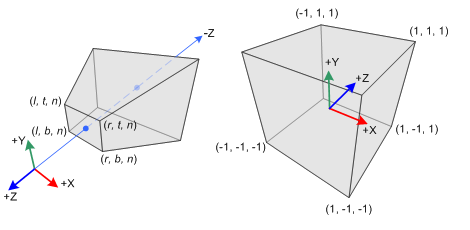
Perspective Projection
General Perspective Projection Matrix
The mapping of the range $[l,r]$ to the range $[-1,1]$ can be split into two steps:
- Project all the points to the near plane. This way, all the $x$- and $y$-coordinates will be inside the range $[l,r] \times [b,t]$.
- Map all the values in the range $[l,r]$ and $[b,t]$ to the range $[-1, 1]$.
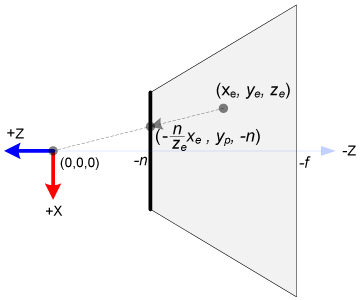
Top view of the frustum
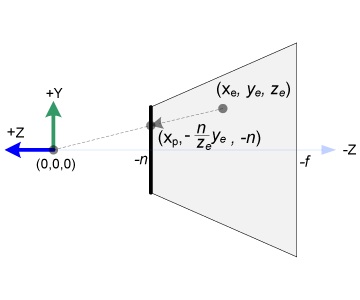
Side view of the frustum
Let $\mathbf{v}_{view}$ be a vector in view space which is going to be transformed to clip space. By similar triangles, we see that the value of $x_p$ and $y_p$ (the coordinates projected to the near plane) is:
$$ \begin{align*} \frac{x_p}{x_{view}} &= \frac{-n}{z_{view}} \quad \quad x_p = \frac{n \cdot x_{view}}{-z_{view}} \\ \frac{y_p}{y_{view}} &= \frac{-n}{z_{view}} \quad \quad y_p = \frac{n \cdot y_{view}}{-z_{view}} \end{align*} $$
Note that both quantities are inversely proportional to $-z_{view}$. What we can do is manipulate the coordinate so that it has a common denominator:
$$ \begin{bmatrix} \tfrac{n \cdot x_{view}}{-z_{view}} & \tfrac{n \cdot y_{view}}{-z_{view}} & n \tfrac{z_{view}}{-z_{view}} \end{bmatrix}^T = \frac{ \begin{bmatrix} n \cdot x_{view} & n \cdot y_{view} & n \cdot z_{view} \end{bmatrix}^T }{-z_{view}} $$
The point in homogeneous coordinates is:
$$ \begin{bmatrix} n \cdot x_{view} & n \cdot y_{view} & n \cdot z_{view}& \tfrac{1}{-z_{view}} \end{bmatrix}^T $$
The pipeline then projects any homogeneous coordinate onto the $w = 1$ hyperplane by dividing each coordinate by $w$. This division, the perspective divide, is done later in the pipeline, not by the application.
We can take advantage of this process and use $-z_{view}$ as our $w$. With this in mind, we can construct a transformation matrix so that transformed points have $w = -z_{view}$:
$$ \begin{align*} \begin{bmatrix} x_{clip} \\ y_{clip} \\ z_{clip} \\ w_{clip} \end{bmatrix} &= \begin{bmatrix} . & . & . & . \\ . & . & . & . \\ . & . & . & . \\ 0 & 0 & -1 & 0 \end{bmatrix} \begin{bmatrix} x_{view} \\ y_{view} \\ z_{view} \\ w_{view} \end{bmatrix} \\ \therefore w_{clip} &= -z_{view} \end{align*} $$
Where $x_{clip}, y_{clip}, z_{clip}, w_{clip}$ are expressed in terms of the clip space. When each coordinate is divided by $w_{clip}$, we’ll have NDC:
$$ \begin{bmatrix} x_{ndc} \\ y_{ndc} \\ z_{ndc} \end{bmatrix} = \begin{bmatrix} x_{clip}/w_{clip} \\ y_{clip}/w_{clip} \\ z_{clip}/w_{clip} \end{bmatrix} $$
Next, $x_p$ and $y_p$ are mapped linearly to $[-1,1]$. We can reuse the linear mapping derived above:
$$ \begin{align*} x_{ndc} = \frac{2}{r - l}x_p - \frac{r + l}{r - l} \\ y_{ndc} = \frac{2}{t - b}y_p - \frac{t + b}{t - b} \end{align*} $$
Next, we substitute $x_p$ into $x_{ndc}$:
$$ \begin{align*} x_{ndc} &= \frac{2}{r - l}\frac{n \cdot x_{view}}{-z_{view}} - \frac{r + l}{r - l} \\ &= \frac{2n}{r - l} \frac{x_{view}}{-z_{view}} - \frac{r + l}{r - l} \frac{-z_{view}}{-z_{view}} \\ &= \left ( \frac{2n}{r - l} x_{view} + \frac{r + l}{r - l} z_{view} \right ) \big / -z_{view} \end{align*} $$
Note that the second fraction is manipulated so that it’s also divisible by $-z_{view}$. Also, note that the quantity in the parenthesis is in clip space coordinates: $x_{clip}$.
$$ x_{clip} = \frac{2n}{r - l} x_{view} + \frac{r + l}{r - l} z_{view} $$
Similarly, the value of $y_{clip}$ is:
$$ y_{clip} = \frac{2n}{t - b} y_{view} + \frac{t + b}{t - b} z_{view} $$
Combining the $w$ row with the $x_{clip}$ and $y_{clip}$ rows gives:
$$ \begin{equation*} \begin{bmatrix} x_{clip} \\ y_{clip} \\ z_{clip} \\ w_{clip} \end{bmatrix} = \begin{bmatrix} \tfrac{2n}{r - l} & 0 & \tfrac{r + l}{r - l} & 0 \\ 0 & \tfrac{2n}{t - b} & \tfrac{t + b}{t - b} & 0 \\ . & . & . & . \\ 0 & 0 & -1 & 0 \end{bmatrix} \begin{bmatrix} x_{view} \\ y_{view} \\ z_{view} \\ w_{view} \end{bmatrix} \end{equation*} $$
Next, we need to find the value of $z_{clip}$. Note that the projected value is always a constant because the $z_{clip}$ component depends on $z_{view}$ and is also divided by $-z_{view}$. We need $z_{clip}$ to be unique for the clipping and depth test. Plus, we should be able to unproject it (through an inverse transformation).
Since $z_{ndc}$ doesn’t depend on $x_{view}$ or $y_{view}$, we can borrow the $w$-coordinate to find the relationship between $z_{ndc}$ and $z_{view}$. With that in mind, we can make the third row of the matrix equal to:
$$ \begin{equation*} \begin{bmatrix} x_{clip} \\ y_{clip} \\ z_{clip} \\ w_{clip} \end{bmatrix} = \begin{bmatrix} \tfrac{2n}{r - l} & 0 & \tfrac{r + l}{r - l} & 0 \\ 0 & \tfrac{2n}{t - b} & \tfrac{t + b}{t - b} & 0 \\ 0 & 0 & A & B \\ 0 & 0 & -1 & 0 \end{bmatrix} \begin{bmatrix} x_{view} \\ y_{view} \\ z_{view} \\ w_{view} \end{bmatrix} \end{equation*} $$
Then $z_{ndc}$ has the form:
$$ z_{ndc} = \frac{z_{clip}}{w_{clip}} = \frac{Az_{view} + Bw_{view}}{-z_{view}} $$
Since $w_{view}=1$ in view space:
$$ z_{ndc} = \frac{Az_{view} + B}{-z_{view}} $$
Note that the value is not linear, but it needs to be mapped to $[-n, -f] \mapsto [-1,1]$. Substituting the desired output range $[-1, 1]$ as $z_{ndc}$, we have a system of equations:
$$ \begin{cases} -1 &= \frac{-An + B}{n} \\ 1 &= \frac{-Af + B}{f} \end{cases} \rightarrow \begin{cases} -An + B &= -n \\ -Af + B &= f \end{cases} $$
Subtracting the second equation from the first:
$$ \begin{align*} -An + B + Af - B &= -n - f \\ A (f - n) &= -n - f \\ A = -\frac{f + n}{f - n} \end{align*} $$
Solving for $B$ given $A$:
$$ \frac{f + n}{f - n}n + B = -n $$
$$ \begin{align*} B &= -n - \frac{f + n}{f - n}n \\ &= \frac{-fn + n^2 - fn - n^2}{f - n} \\ &= \frac{-2fn}{f - n} \\ \end{align*} $$
Substituting the values of $A$ and $B$, we have the general perspective projection matrix:
$$ \begin{equation*} \mathbf{M}_{proj} = \begin{bmatrix} \tfrac{2n}{r - l} & 0 & \tfrac{r + l}{r - l} & 0 \\ 0 & \tfrac{2n}{t - b} & \tfrac{t + b}{t - b} & 0 \\ 0 & 0 & -\tfrac{f + n}{f - n} & \tfrac{-2fn}{f - n} \\ 0 & 0 & -1 & 0 \end{bmatrix} \end{equation*} $$
Symmetric Perspective Projection Matrix
If the viewing volume is symmetric, i.e., $r = -l$ and $t = -b$, then some quantities can be simplified:
$$ \begin{aligned} r + l = 0, \quad r - l = 2r \\ t + b = 0, \quad t - b = 2t \end{aligned} $$
Then the symmetric matrix becomes:
$$ \begin{equation*} \mathbf{M}_{proj} = \begin{bmatrix} \tfrac{n}{r} & 0 & 0 & 0 \\ 0 & \tfrac{n}{t} & 0 & 0 \\ 0 & 0 & -\tfrac{f + n}{f - n} & \tfrac{-2fn}{f - n} \\ 0 & 0 & -1 & 0 \end{bmatrix} \end{equation*} $$
Symmetric Perspective Projection Matrix from Field of View/Aspect
gluPerspective
receives, instead of the $x$ and $y$ bounds, two arguments:
- field of view ($fov$), which specifies the field of view angle in the $y$ direction.
- aspect ($aspect$), which is the aspect ratio that determines the field of view in the $x$ direction, calculated as $\tfrac{x}{y}$. The value is commonly $\tfrac{screen\ width}{screen\ height}$.
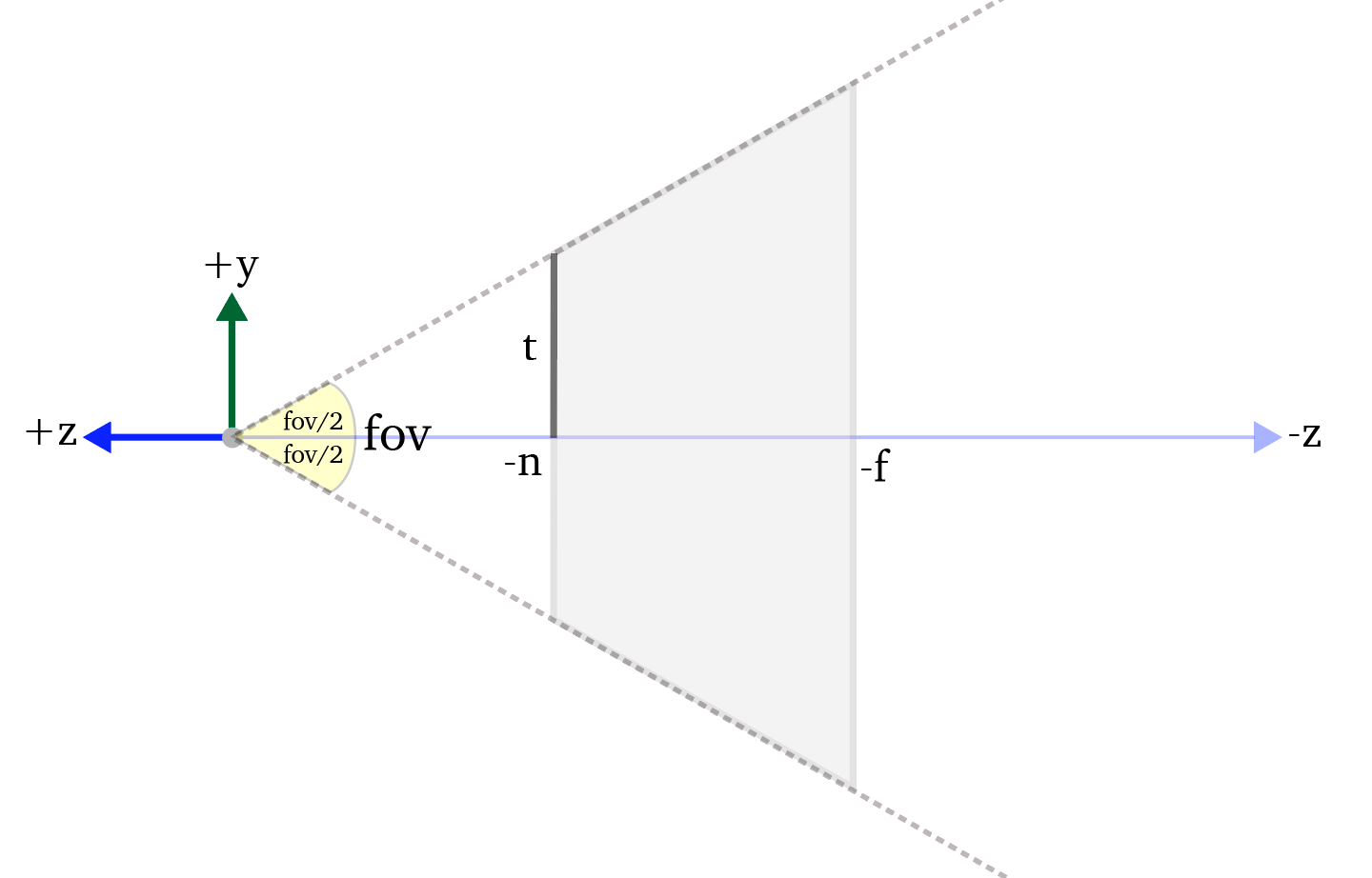
fov
We see that the value of $t$ (top) is:
$$ \begin{align*} \tan{ (fov/2) } &= \frac{t}{n} \\ t &= n \cdot \tan{ (fov/2) } \end{align*} $$
We can find the value of $r$ (right) with the aspect ratio:
$$ \begin{align*} aspect &= \frac{2r}{2t} = \frac{r}{t} \\ r &= aspect \cdot t \\ &= aspect \cdot n \cdot \tan{(fov/2)} \end{align*} $$
Substituting the expressions for $t$ and $r$ into the symmetric matrix:
$$ \begin{equation*} \mathbf{M}_{proj} = \begin{bmatrix} \tfrac{1}{aspect \cdot \tan{ (fov/2) } } & 0 & 0 & 0 \\ 0 & \frac{1}{\tan{ (fov/2) }} & 0 & 0 \\ 0 & 0 & -\tfrac{f + n}{f - n} & \tfrac{-2fn}{f - n} \\ 0 & 0 & -1 & 0 \end{bmatrix} \end{equation*} $$