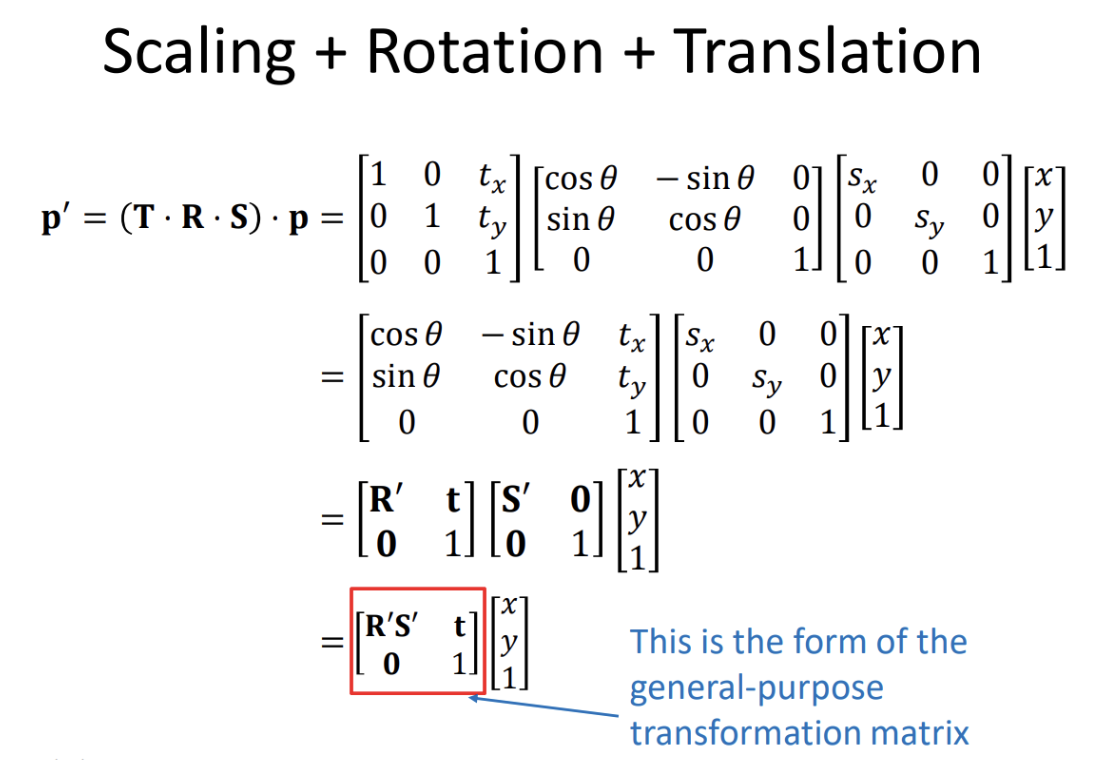


Multiplying a vector by a matrix applies one transformation. Multiplying two matrices produces a third matrix that applies both transformations in sequence, so a chain of transformations collapses into a single matrix.
Rendering is one place where this matters. An object’s vertices are expressed in several spaces before they reach the screen. The model transform $\mathbf{M}_{\text{world} \leftarrow \text{object}}$ moves vertices from object space to world space, and the view transform $\mathbf{M}_{\text{view} \leftarrow \text{world}}$ moves them from world space to view space:
$$ \begin{aligned} \mathbf{v}_{\text{world}} &= \mathbf{M}_{\text{world} \leftarrow \text{object}} \mathbf{v}_{\text{object}} \\ \mathbf{v}_{\text{view}} &= \mathbf{M}_{\text{view} \leftarrow \text{world}} \mathbf{v}_{\text{world}} \\ &= \mathbf{M}_{\text{view} \leftarrow \text{world}} \mathbf{M}_{\text{world} \leftarrow \text{object}} \mathbf{v}_{\text{object}} \end{aligned} $$
Because matrix multiplication composes transformations, the two hops combine into a single matrix, $\mathbf{M}_{\text{view} \leftarrow \text{object}} = \mathbf{M}_{\text{view} \leftarrow \text{world}} \mathbf{M}_{\text{world} \leftarrow \text{object}}$, which transforms vertices directly from object space to view space:
$$ \begin{aligned} \mathbf{v}_{\text{view}} &= (\mathbf{M}_{\text{view} \leftarrow \text{world}} \mathbf{M}_{\text{world} \leftarrow \text{object}})\mathbf{v}_{\text{object}} \\ &= \mathbf{M}_{\text{view} \leftarrow \text{object}} \mathbf{v}_{\text{object}} \end{aligned} $$
Order matters: rotation followed by translation $\mathbf{T}\mathbf{R}$ and translation followed by rotation $\mathbf{R}\mathbf{T}$ give different results, and the rest of this article shows why. The same composition powers the view transform , a change between coordinate systems, covered in its own article.
Rotation Followed by Translation
Apply a rotation and then a translation to a vector $\mathbf{v}$:
$$ \mathbf{v}^\prime = \mathbf{T} \mathbf{R} \mathbf{v} $$
Multiplying the two matrices gives:
$$ \mathbf{T} \mathbf{R} = \begin{bmatrix} \mathbf{I}_{3 \times 3} & \mathbf{T}_{3 \times 1} \\ \mathbf{0}_{1 \times 3} & 1 \end{bmatrix} \begin{bmatrix} \mathbf{R}_{3 \times 3} & \mathbf{0}_{3 \times 1} \\ \mathbf{0}_{1 \times 3} & 1 \end{bmatrix} = \begin{bmatrix} \mathbf{R}_{3 \times 3} & \mathbf{T}_{3 \times 1} \\ \mathbf{0}_{1 \times 3} & 1 \end{bmatrix} $$
Applied to $\mathbf{v}$:
$$ \mathbf{v}^\prime = \mathbf{T} \mathbf{R} \mathbf{v} = \begin{bmatrix} \mathbf{R}_{3 \times 3} & \mathbf{T}_{3 \times 1} \\ \mathbf{0}_{1 \times 3} & 1 \end{bmatrix} \begin{bmatrix} \mathbf{v}_{3 \times 1} \\ 1 \end{bmatrix} = \begin{bmatrix} \mathbf{R}_{3 \times 3} \mathbf{v}_{3 \times 1} + \mathbf{T}_{3 \times 1} \\ 1 \end{bmatrix} $$
In compact form:
$$ \mathbf{v}^\prime = \mathbf{T} \mathbf{R} \mathbf{v} = \mathbf{R} \mathbf{v} + \mathbf{T}_{3 \times 1} $$
Translation Followed by Rotation
Apply a translation and then a rotation to the same vector $\mathbf{v}$:
$$ \mathbf{v}^\prime = \mathbf{R} \mathbf{T} \mathbf{v} $$
Multiplying the two matrices in this order gives:
$$ \mathbf{R} \mathbf{T} = \begin{bmatrix} \mathbf{R}_{3 \times 3} & \mathbf{0}_{3 \times 1} \\ \mathbf{0}_{1 \times 3} & 1 \end{bmatrix} \begin{bmatrix} \mathbf{I}_{3 \times 3} & \mathbf{T}_{3 \times 1} \\ \mathbf{0}_{1 \times 3} & 1 \end{bmatrix} = \begin{bmatrix} \mathbf{R}_{3 \times 3} & \mathbf{R}_{3 \times 3} \mathbf{T}_{3 \times 1} \\ \mathbf{0}_{1 \times 3} & 1 \end{bmatrix} $$
Applied to $\mathbf{v}$:
$$ \mathbf{v}^\prime = \mathbf{R} \mathbf{T} \mathbf{v} = \begin{bmatrix} \mathbf{R}_{3 \times 3} & \mathbf{R}_{3 \times 3} \mathbf{T}_{3 \times 1} \\ \mathbf{0}_{1 \times 3} & 1 \end{bmatrix} \begin{bmatrix} \mathbf{v}_{3 \times 1} \\ 1 \end{bmatrix} = \begin{bmatrix} \mathbf{R}_{3 \times 3} \mathbf{v}_{3 \times 1} + \mathbf{R}_{3 \times 3} \mathbf{T}_{3 \times 1} \\ 1 \end{bmatrix} $$
In compact form:
$$ \mathbf{v}^\prime = \mathbf{R} \mathbf{T} \mathbf{v} = \mathbf{R} \mathbf{v} + \mathbf{R}\mathbf{T}_{3 \times 1} $$
Note that both the vector $\mathbf{v}$ and the translation are transformed by $\mathbf{R}$.
The Product of Two Transformations
The two products differ because of a general property of matrix multiplication. For two transformation matrices $\mathbf{M}$ and $\mathbf{N}$ applied to a vector in that order, the product is:
$$ \mathbf{NM} = \begin{bmatrix} \mathbf{\hat{s}} & \mathbf{\hat{t}} & \mathbf{\hat{u}} \end{bmatrix} \begin{bmatrix} \mathbf{\hat{p}} & \mathbf{\hat{q}} & \mathbf{\hat{r}} \end{bmatrix} = \begin{bmatrix} p_x \mathbf{s} + p_y \mathbf{t} + p_z \mathbf{u} \\ q_x \mathbf{s} + q_y \mathbf{t} + q_z \mathbf{u} \\ r_x \mathbf{s} + r_y \mathbf{t} + r_z \mathbf{u} \end{bmatrix}^T $$
The rows of the product are the result of transforming the basis vectors of $\mathbf{M}$ by the transformation matrix $\mathbf{N}$, so matrix-matrix multiplication encodes a basis transformation. In $\mathbf{T}\mathbf{R}$ the rotation acts on the vector and leaves the translation column as $\mathbf{T}$. In $\mathbf{R}\mathbf{T}$ the rotation acts on the translation as well, producing $\mathbf{R}\mathbf{T}$. In general, $\mathbf{T}\mathbf{R} \neq \mathbf{R}\mathbf{T}$.
Interactive 3D Transformation Chain Simulator
Matrix composition operates identically to nested function application:
$$ (\mathbf{T} \circ \mathbf{R} \circ \mathbf{S})(\mathbf{v}) = \mathbf{T}(\mathbf{R}(\mathbf{S}(\mathbf{v}))) = \mathbf{T}\mathbf{R}\mathbf{S}\mathbf{v} $$
Because matrix-vector multiplication is functional application, transformation chains evaluate from right to left: the innermost transformation $\mathbf{S}$ acts first on the vector $\mathbf{v}$, followed by $\mathbf{R}$, and finally $\mathbf{T}$. Toggling between Standard TRS (scaling and rotating in place at the origin, then translating) versus Orbit RTS (translating first, which swings the object around the origin during rotation) visualizes the non-commutativity derived above ($\mathbf{TR} \neq \mathbf{RT}$). Hovering over any matrix symbol reveals its exact 4x4 matrix formulation.
Key Takeaways
| Concept | Formula | Takeaway |
|---|---|---|
| Composition | $\mathbf{v}^\prime = \mathbf{N}\mathbf{M}\mathbf{v}$ | Matrices apply right to left, so a chain of transformations collapses into a single matrix. |
| Order matters | $\mathbf{T}\mathbf{R} \neq \mathbf{R}\mathbf{T}$ | Rotating after translating differs from translating after rotating. |
| Rotation then translation | $\mathbf{v}^\prime = \mathbf{R}\mathbf{v} + \mathbf{T}$ | The rotation applies first, then the translation, and the translation is never rotated. |
| Translation then rotation | $\mathbf{v}^\prime = \mathbf{R}\mathbf{v} + \mathbf{R}\mathbf{T}$ | The rotation applies last and rotates the translation along with the vector. |
| Scene Graph TRS | $\mathbf{M} = \mathbf{T}\mathbf{R}(q)\mathbf{S}$ | 3D engines store rotations as quaternions $q$ for smooth SLERP blending before constructing $\mathbf{R}(q)$. |