
Scaling Along the Cardinal Axes
Intuitively, the basis vectors should be multiplied by a scalar. Also, they are independently affected by the scale factors.
In 2D, the basis vectors become:
$$ \mathbf{p}^\prime = k_x \mathbf{p} = k_x \begin{bmatrix} 1 \\ 0 \end{bmatrix} = \begin{bmatrix} k_x \\ 0 \end{bmatrix} \\ \mathbf{q}^\prime = k_y \mathbf{q} = k_y \begin{bmatrix} 0 \\ 1 \end{bmatrix} = \begin{bmatrix} 0 \\ k_y \end{bmatrix} $$
Constructing the 2D scale matrix $\mathbf{S}(k_x, k_y)$ from these basis vectors:
$$ \mathbf{S}(k_x, k_y) = \begin{bmatrix} k_x & 0 \\ 0 & k_y \end{bmatrix} $$
Similarly, the 3D scale matrix is given by:
$$ \mathbf{S}(k_x, k_y, k_z) = \begin{bmatrix} k_x & 0 & 0 \\ 0 & k_y & 0 \\ 0 & 0 & k_z \end{bmatrix} $$
Scaling Along an Arbitrary Axis
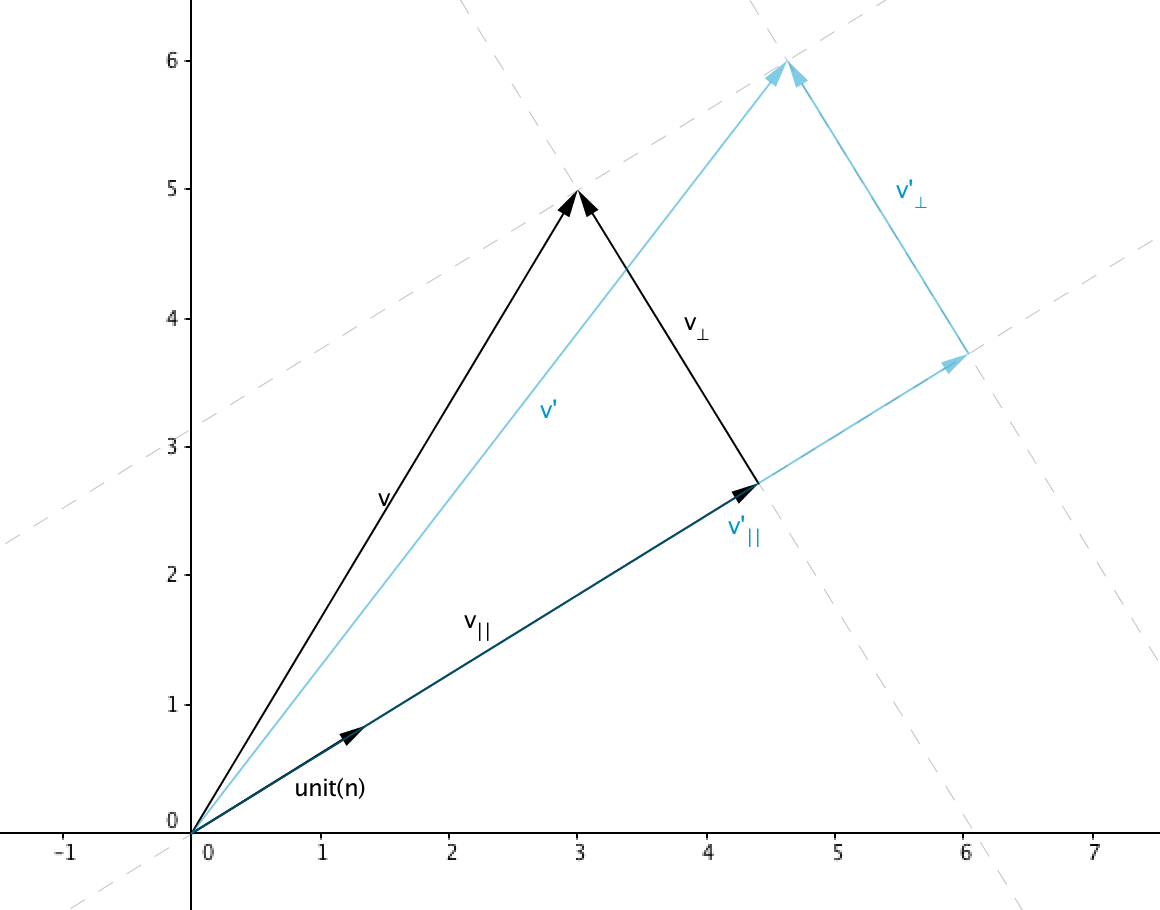
Let $\hat{\mathbf{n}}$ be the unit vector parallel to the direction of scale and $k$ to be the scale factor. A vector transformed by this scale operation can be represented as:
$$ \mathbf{v}^\prime = \mathbf{S}(\hat{\mathbf{n}}, k) \mathbf{v} $$
Scale Arbitrary Axis
Separate $\mathbf{v}$ into two vectors: a vector parallel to $\hat{\mathbf{v}}$ called $\mathbf{v_{\parallel}}$ and a vector perpendicular to $\hat{\mathbf{v}}$ called $\mathbf{v_{\perp}}$ such that:
$$ \mathbf{v} = \mathbf{v_{\parallel}} + \mathbf{v_{\perp}} $$
Where:
$$ \begin{align*} \mathbf{v_{\parallel}} &= (\mathbf{v} \cdot \hat{\mathbf{n}}) \hat{\mathbf{n}} \\ \mathbf{v_{\perp}} &= \mathbf{v} - \mathbf{v_{\parallel}} \end{align*} $$
We can also represent $\mathbf{v}^\prime$ as a sum of two vectors parallel and perpendicular to $\hat{\mathbf{n}}$:
$$ \mathbf{v}^\prime = \mathbf{v_{\parallel}}^\prime + \mathbf{v_{\perp}}^\prime $$
Note that any vector that lies in the 2D line or 3D plane perpendicular to $\hat{\mathbf{n}}$ will not be affected by the scale operation, so $\mathbf{v}^\prime = \mathbf{v_{\parallel}}^\prime + \mathbf{v_{\perp}}$.
Since $\mathbf{v_{\parallel}}$ is parallel to the direction of scale, then $\mathbf{v_{\parallel}}^\prime = k\mathbf{v_{\parallel}}$.
Reconstructing the solution from the observations above:
$$ \begin{align*} \mathbf{v_{\parallel}} &= (\mathbf{v} \cdot \hat{\mathbf{n}}) \hat{\mathbf{n}} \\ \mathbf{v_{\perp}}^\prime &= \mathbf{v_{\perp}} \\ &= \mathbf{v} - \mathbf{v_{\parallel}} \\ &= \mathbf{v} - (\mathbf{v} \cdot \hat{\mathbf{n}}) \hat{\mathbf{n}} \\ \mathbf{v_{\parallel}}^\prime &= k\mathbf{v_{\parallel}} \\ &= k(\mathbf{v} \cdot \hat{\mathbf{n}}) \hat{\mathbf{n}} \\ \mathbf{v}^\prime &= \mathbf{v_{\perp}}^\prime + \mathbf{v_{\parallel}}^\prime \\ &= \mathbf{v} - (\mathbf{v} \cdot \hat{\mathbf{n}}) \hat{\mathbf{n}} + k(\mathbf{v} \cdot \hat{\mathbf{n}}) \hat{\mathbf{n}} \\ &= \mathbf{v} + (k - 1) (\mathbf{v} \cdot \hat{\mathbf{n}}) \hat{\mathbf{n}} \end{align*} $$
We can construct a general scale matrix by computing the vectors resulting after transforming the basis vectors $\mathbf{p}$, $\mathbf{q}$, and $\mathbf{r}$. For example, let’s transform $\mathbf{p} = \begin{bmatrix} 1 & 0 & 0 \end{bmatrix}^T$:
$$ \begin{align*} \mathbf{p}^\prime &= \mathbf{p} + (k - 1) (\mathbf{p} \cdot \hat{\mathbf{n}}) \hat{\mathbf{n}} \\ &= \begin{bmatrix} 1 \\ 0 \\ 0 \end{bmatrix} + (k - 1) \left ( \begin{bmatrix} 1 \\ 0 \\ 0 \end{bmatrix} \begin{bmatrix} n_x \\ n_y \\ n_z \end{bmatrix}^T \right ) \begin{bmatrix} n_x \\ n_y \\ n_z \end{bmatrix} \\ &= \begin{bmatrix} 1 \\ 0 \\ 0 \end{bmatrix} + (k - 1) n_x \begin{bmatrix} n_x \\ n_y \\ n_z \end{bmatrix} \\ &= \begin{bmatrix} 1 + (k - 1) {n_x}^2 \\ (k - 1)n_xn_y \\ (k - 1)n_xn_z \end{bmatrix} \end{align*} $$
Similarly, the values of $\mathbf{q}^\prime$ and $\mathbf{r}^\prime$ can be found, which make the general rotation matrix equal to:
$$ \begin{align*} \mathbf{S}(\hat{\mathbf{n}}, k) &= \begin{bmatrix} \mathbf{p}^\prime & \mathbf{q}^\prime & \mathbf{r}^\prime \end{bmatrix} \\ & = \begin{bmatrix} 1 + (k - 1) {n_x}^2 & (k - 1)n_yn_x & (k - 1)n_zn_x \\ (k - 1)n_xn_y & 1 + (k - 1) {n_y}^2 & (k - 1)n_zn_y \\ (k - 1)n_xn_z & (k - 1)n_yn_z & 1 + (k - 1) {n_z}^2 \end{bmatrix} \end{align*} $$