Shading is the process of altering the color of a surface. Different shading models capture the process of light reflection on a surface. These models use the following variables in the computation:
- $\mathbf{ray}$ (ray) - a ray emitted from a pixel, defined with an origin ($\mathbf{ray}_{\text{origin}}$) and a direction ($\mathbf{ray}_{\text{direction}}$).
- $\mathbf{p}$ (intersection point) - the intersection point of the surface and $\mathbf{ray}$.
- $\mathbf{l}$ (light direction) - a unit vector pointing from the surface towards a light source, computed by normalizing the vector between the intersection point $\mathbf{p}$ and the light source position $\mathbf{l}_{s}$.
$$ \mathbf{l} = \frac{\mathbf{l}_{s} - \mathbf{p}}{\lVert \mathbf{l}_{s} - \mathbf{p} \rVert} $$
- $\mathbf{v}$ (view direction) - a unit vector pointing from the surface towards the place the ray is emitted from. It’s computed by normalizing the vector between the intersection point $\mathbf{p}$ and the ray origin $\mathbf{ray}_{\text{origin}}$.
$$ \mathbf{v} = \frac{\mathbf{ray}_{\text{origin}} - \mathbf{p}}{\lVert \mathbf{ray}_{\text{origin}} - \mathbf{p} \rVert} $$
- $\mathbf{n}$ (surface normal) - a unit vector perpendicular to the surface at the point where the reflection is taking place.
- Other characteristics of the light source and the surface, depending on the shading model.
Flat Shading
Flat shading is the simplest shading model, which calculates the illumination at a single point for each polygon (or polygon vertices in OpenGL). This means that the color is the same for all points of each polygon.
Advantages
- Fast: a single computation per polygon (or one per polygon vertex in OpenGL).
Disadvantages
- Inaccurate.
- Discontinuities at polygon boundaries.
Implementation
GLSL has the keyword flat to skip interpolation.
// vertex shader
flat out vec4 polygon_color;
void main() {
  // ...
  polygon_color = vec4(ambient + diffuse + specular, 1.0);
}

// fragment shader
flat in vec4 polygon_color;
out vec4 color;
void main () {
  color = polygon_color;
}
Flat shading assigns one color per polygon. The rest of this article covers models that shade each point individually, starting with the Lambertian model for matte surfaces.
Diffuse Shading
Many objects, for example wood and paper, have a surface that is not shiny. Such objects can be modeled with the Lambertian model, which obeys Lambert’s cosine law:
The luminous intensity of a surface is proportional to the cosine of the angle between the surface normal and the direction of the light.
$$ c \propto \cos\theta \quad \text{or} \quad c \propto \mathbf{n} \cdot \mathbf{l} $$
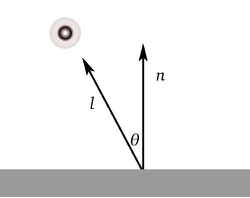
The model does not depend on the distance between the light and the object. This is equivalent to saying the light is distant relative to the object size, which is often a directional light.
When light hits the surface, a portion is reflected, controlled by the diffuse reflectance $c_r$, a color that varies with the surface. The surface color can be made darker or lighter by changing the color of the light source $c_l$:
$$ c = c_r ; c_l ; \mathbf{n} \cdot \mathbf{l} $$
$c_r$ and $c_l$ are RGB colors with components in $[0, 1]$, where the multiplication is element-wise. The product $\mathbf{n} \cdot \mathbf{l}$ can be negative, for example when the surface normal points away from the light. Clamping with the max function keeps the result valid:
$$ c = c_r ; c_l ; \text{max}(\mathbf{n} \cdot \mathbf{l}, 0) $$
Blinn-Phong Shading
Many surfaces show highlights (shininess) or specular reflections that appear to move as the viewpoint changes. The idea is to produce a reflection when $\mathbf{v}$ and $\mathbf{l}$ are positioned symmetrically across the surface normal.
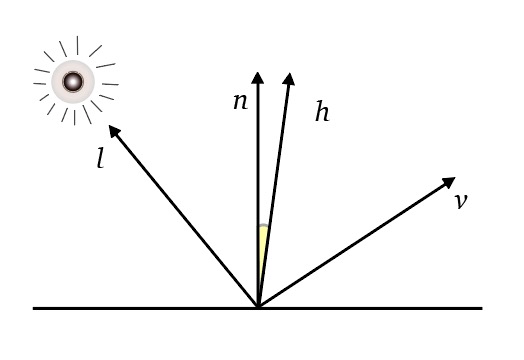
Blinn-Phong
The half vector $\mathbf{h}$ is a unit vector through the bisector of the angle between $\mathbf{v}$ and $\mathbf{l}$:
$$ \mathbf{h} = \frac{\mathbf{v + l}}{\lVert \mathbf{v + l} \rVert} $$
The specular component is bright when $\mathbf{h}$ is near $\mathbf{n}$ and dim when it is far, so it is proportional to the cosine of the angle between $\mathbf{n}$ and $\mathbf{h}$, i.e. $\mathbf{n \cdot h} = \cos\theta$. Raising the result to a power $p > 1$ makes it decrease faster:
$$ L = k_d \cdot I \cdot \text{max}(0, \mathbf{n \cdot l}) + k_s \cdot I \cdot \text{max}(0, \mathbf{n \cdot h})^p $$
Where $k_s$ is the specular coefficient and $I$ is the intensity of the light source.
Ambient Shading
Surfaces that receive no illumination would be rendered completely black. To avoid this, a constant component is added to the shading model. The ambient color $c_a$ depends on the object but not on its geometry:
$$ c = c_r \cdot c_a $$